

Flight Physics

Entry posted by krdavis18
935 views
Flight is a magnificent natural ability of birds and what seems like a tremendous accomplishment for man-made aircraft's that average at a weight of over 300 tons. So I thought I would explore more into this amazing ability and the physics behind it. Here is what I learned.
In order to fly, a bird or a plane must overcome both the force of gravity and drag forces as it is moving through the air. The force that opposes weight is known as lift and the force that opposes drag is called thrust. Lift is generated from the shape of the wings that cause air to move faster over the top of the wings and slower underneath. This means that there is lower air pressure above the wings and higher air pressure underneath them. The force from the pressure difference which is called the life force, exceeds the weight of the bird and the bird is able to fly. Here is an image demonstrating what is called the Bernoulli effect.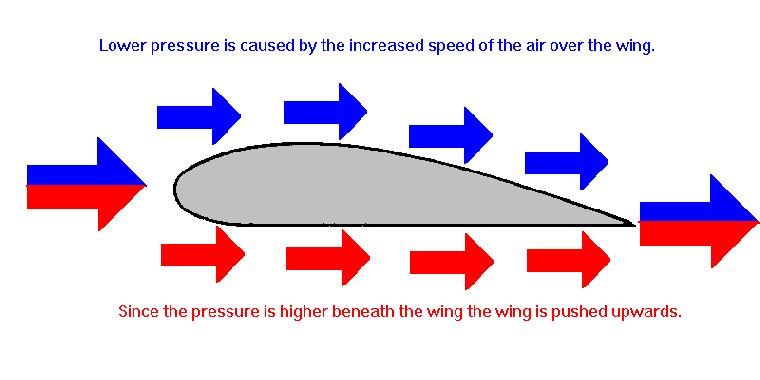
When you look into an amount of lift that a pair of wings can produce, you have to take in to consideration factors such as wing size, air speed, air density, and the angle of the wings with respect to the direction of the flight. A wings lift is directly proportional to the surface area of the wing, so a wing twice as large can carry twice as much weight. To simplify the relationship between lift and airspeed and air density, it can be said that if a bird flies twice as fast, it can generate four times as much lift. And if a plane flies where the air density is a quarter of the density of the air at sea level, then it must fly twice as fast to maintain the same amount of lift. Lastly, lift increases as angle of attack increases, but only up to a certain critical angle. The angle of attack is the angle between the wing and the direction of the oncoming wind. Past that critical angle, stall occurs as the air stops flowing smoothly over the top surface and instead peels away, leaving a turbulent wake.
Prettu interesting!! To read more on this topic and where I found most of my information, check out this presentation:
0 Comments
Recommended Comments
There are no comments to display.