(As adapted from several sources, beginning with Jim Davidson, Physics Teacher)
I. Mechanics
1. Mass and inertia are the same thing. (Mass actually measures inertia – in kilograms… Much as monetary resources measures financial wealth – in dollars.)
 2. Weight (force of gravity) decreases as you move away from the earth by distance squared. (It decreases, but only approaches zero, never reaching it, even far beyond the solar system.)
3. Weight (in newtons) is mass * acceleration (w = mg). Mass is not Weight! Mass is a scalar and measured in kilograms, weight is a force and a vector and measured in Newtons.
4. Velocity can only be constant when the net force (and acceleration) is zero. (The velocity can be zero and not constant – for example when a ball, thrown vertically, is at the top of its trajectory.)
5. Velocity, displacement [s], momentum, force (weight), torque, and acceleration are vectors.
6. Speed, distance [d], time, length, mass, temperature, charge, power and energy (joules) are scalar quantities.
7. The slope of the distance-time graph is velocity.
8. The slope of the velocity-time graph is acceleration.
9. The area under a velocity-time graph is distance.
10. Magnitude is a term used to state how large a vector quantity is.
11. At zero (0) degrees two vectors have a resultant equal to their sum. At 180 degrees two vectors have a resultant equal to their difference. From the minimum value (at 180) to the maximum value (at zero) is the total range of all the possible resultants of any two vectors.
12. An unbalanced force must produce an acceleration and the object cannot be in equilibrium.
13. If an object is not accelerating, it is in equilibrium and no unbalanced forces are acting.
14. The equilibrant force is equal in magnitude but opposite in direction to the resultant vector.
15. Momentum is conserved in all collision systems. Energy is conserved (in the KE of the objects) only if a collision is perfectly elastic.
II. Energy
16. Mechanical energy is the sum of the potential and kinetic energy.
17. UNITS: a = [m/sec2]; F = [kg•m/sec2] = Newton; work = PE = KE = [kg•m2/sec2] = Joule; Power = [kg•m2/sec3] = [Joules/sec] = Watt
18. 1ev is a very small energy unit equal to 1.6 x 10⁻¹⁹ joules – used for small objects like electrons. This is on the Reference Table.
19. Gravitational potential energy increases as height increases.
20. Kinetic energy changes only if mass or velocity changes.
21. Mechanical energy (PE + KE) does not change for a free falling mass or a swinging pendulum. (when ignoring air friction)
III. Electricity and Magnetism
22. A coulomb is charge, an amp is current [coulomb/sec] and a volt is potential difference [joule/coulomb].
23. Short, fat, cold wires make the best conductors.
24. Electrons and protons have equal amounts of charge (1.6 x 10⁻¹⁹ coulombs each – known as one elementary charge). This is on the Reference Chart.
25. Adding a resistor in series increases the total resistance of a circuit.
26. Adding a resistor in parallel decreases the total resistance of a circuit.
27. All resistors in series have equal current (I).
28. All resistors in parallel have equal voltage (V).
29. If two similar charged spheres touch each other add the charges and divide by two to find the final charge on each sphere after they are separated.
30. Insulators contain no electrons free to move.
31. Ionized gases conduct electric current using positive ions, negative ions and electrons.
32. Electric fields all point in the direction of the force on a positive test charge.
33. Electric fields between two parallel plates are uniform in strength except at the edges.
34. Millikan determined the charge on a single electron using his famous oil-drop experiment.
35. All charge changes result from the movement of electrons not protons. (an object becomes positive by losing electrons)
36. The direction of a magnetic field is defined by the direction a compass needle points. (The direction an isolated north pole would feel.)
37. Magnetic fields point from the north to the south outside the magnet and south to north inside the magnet.
38. Magnetic flux is measured in webers.
39. Left hands are for negative charges and reverse answer for positive charges.
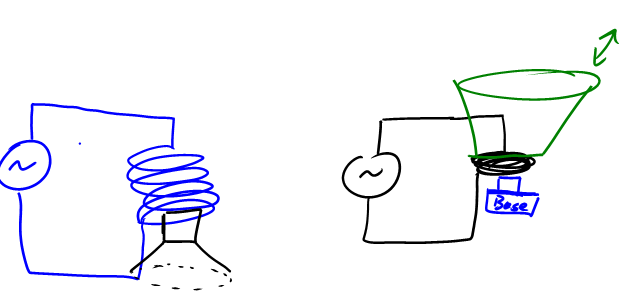
40. The first hand rule deals with the B-field around a current bearing wire, the second hand rule deals with the magnetic field from a wire around a solenoid, and the third hand rule looks at the force on charges moving in a B-field.
41. Solenoids are stronger with more current or more wire turns or adding a soft iron core.
IV. Wave Phenomena
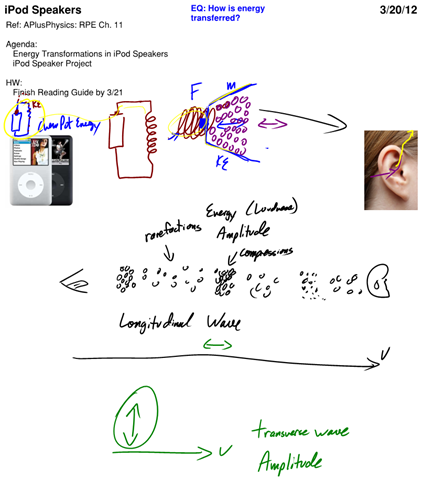
42. Sound waves are longitudinal and mechanical.
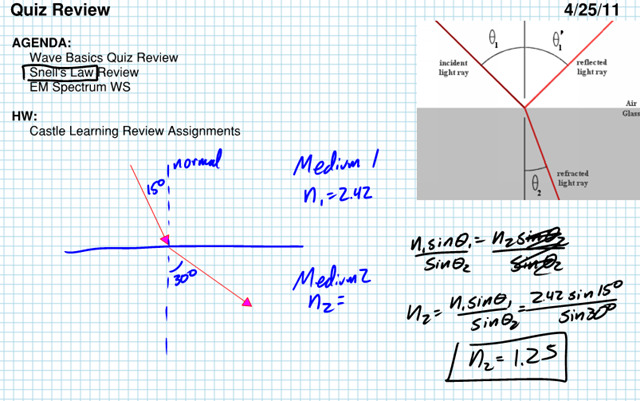
43. Light slows down, bends toward the normal and has a shorter wavelength when it enters a medium with a higher index of refraction (n).
44. All angles in wave theory problems are measured to the normal.
45. Blue light has more energy, a shorter wavelength and a higher frequency than red light (remember- ROYGBIV).
46. The electromagnetic spectrum are listed highest energy (on left) to lowest (on right). They are all electromagnetic waves and travel at the speed of light (c = f *l ).
47. The speed (c) of all types of electromagnetic waves is 3.0 x 10⁸ m/sec in a vacuum.
48. As the frequency of an electromagnetic wave increases its energy increases (E = h * f) and its wavelength decreases and its velocity remains constant as long as it doesn’t enter a medium with a different refractive index (i.e. optical density).
49. A prism produces a rainbow from white light by dispersion. (red bends the least because it slows the least).
50. Transverse wave particles vibrate back and forth perpendicular to the direction of the wave’s velocity. Longitudinal wave particles vibrate back and forth parallel to the direction of the wave’s velocity.
51. Light wave are transverse (they, and all (and only)transverse waves can be polarized).
52. The amplitude of a non-electromagnetic wave (i.e. water, string and sound waves) determines its energy. The frequency determines the pitch of a sound wave. Their wavelength is a function of its frequency and speed (v = f * l ). Their speed depends on the medium they are traveling in.
53. Constructive interference occurs when two waves are zero (0) degrees out of phase or a whole number of wavelengths (360 degrees.) out of phase.
54. At the critical angle a wave will be refracted to 90 degrees. At angles larger than the critical angle, light is reflected not refracted.
55. Doppler effect: when a wave source moves toward you, you will perceive waves with a shorter wavelength and higher frequency than the waves emitted by the source. When a wave source moves away from you, you will perceive waves with a longer wavelength and lower frequency.
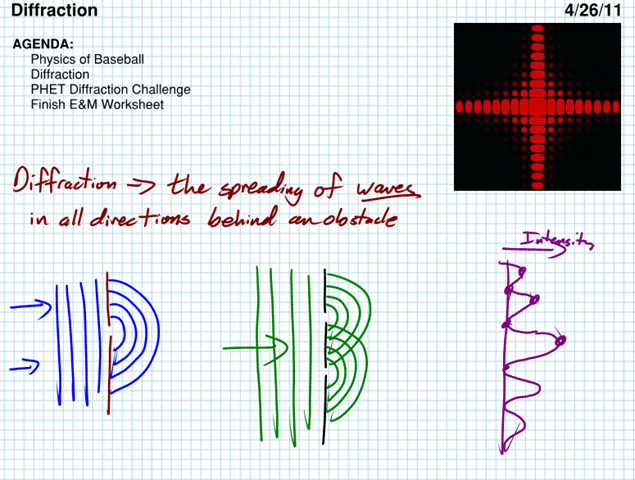
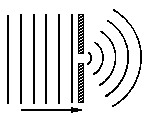
56. Double slit diffraction works because of diffraction and interference.
57. Single slit diffraction produces a much wider central maximum than double slit.
58. Diffuse reflection occurs from dull surfaces while regular (spectacular) reflection occurs from smooth (mirror-like) surfaces.
59. Only waves show diffraction, interference and the polarization.
60. The period of a wave is the inverse of its frequency (T = 1/f ). So waves with higher frequencies have shorter periods.
61. Monochromatic light has one frequency.
62. Coherent light waves are all in phase.
V. Modern Physics
63. In order to explain the photoelectric effect, Einstein proposed particle behavior for light (and all electromagnetic waves) with E = h* f and KEmax = hf – Wo, where W is the work function.
64. A photon is a particle of light (wave packet).
65. To preserve the symmetry of the universe, DeBroglie proposed wave behavior for particles ( l = h/mv). Therefore large fast moving objects (baseballs, rockets) have very short wavelengths (that are unobservable) but very small objects, particularly when moving slowly have wavelengths that can be detected in the behavior of the objects.
66. Whenever charged particles are accelerated, electromagnetic waves are produced.
67. The lowest energy state of a atom is called the ground state.
68. Increasing light frequency increases the kinetic energy of the emitted photo-electrons in the photo-electric effect (KEmax = hf – Wo).
69. As the threshold frequency increases for a photo-cell (photo emissive material) the work function also increases (Wo = h fo)
70. Increasing light intensity increases the number of emitted photo-electrons in the photo-electric effect but not their KE (i.e. more intensity>more photons>more electrons emitted). This is the particle nature shown by light.
VI. Motion in a plane
71. Key to understanding trajectories is to separate the motion into two independent components in different dimensions – normally horizontal and vertical. Usually the velocity in the horizontal dimension is constant (not accelerated) and the motion in the vertical dimension is changing (usually with acceleration of g).
72. Centripetal force and centripetal acceleration vectors are toward the center of the circle- while the velocity vector is tangent to the circle. (Centripetal means towards the center!)
73. An object in orbit is not weightless – it is its weight that keeps it moving in a circle around the astronomical mass it is orbiting. In other words, its weight is the centripetal force keeping it moving in a circle.
74. An object in orbit is in free fall – it is falling freely in response to its own weight. Any object inside a freely falling object will appear to be weightless.
75. Rutherford discovered the positive nucleus using his famous gold-foil experiment.
76. Fusion is the process in which hydrogen is combined to make helium.
77. Fission requires that a neutron causes uranium to be split into middle size atoms and produce extra neutrons, which, in turn, can go on and cause more fissions.
78. Radioactive half-lives are not effected by any changes in temperature or pressure (or anything else for that matter).
79. One AMU of mass is equal to 931 MeV of energy. (E = mc2). This is on the Reference Charts!
80. Nuclear forces are very strong and very short-ranged.
81. There are two basic types of elementary particles: Hadrons & Leptons (see Chart).
82. There are two types of Hadrons: Baryons and Mesons (see Chart).
83. The two types of Hadrons are different because they are made up of different numbers of quarks. Baryons are made up of 3 quarks, and Mesons of a quark and antiquark.
84. Notice that to make long-lived Hadron particles quarks must combine in such a way as to give the charge of particle formed a multiple of the elementary charge.
85. For every particle in the "Standard Model" there is an antiparticle. The major difference of an antipartcle is that its charge is opposite in sign. All antiparticles will anhililate as soon as they come in contact with matter and will release a great amount of energy.
85. Notice that to make long-lived Hadron particles quarks must combine in such a way as to give the charge of particle formed a multiple of the elementary charge.
86. Notice that the retention of the Energy Level Diagrams on the new charts implies that there will be questions on it. The units (eV) can be converted to Joules with the coversion given on the first Chart of the Regents Reference tables. And can be used with the formula (given under Modern Physics formulas) to calculate the energy absorbed or released when the electron changes levels.
And by using another formula (given under Modern Physics formulas) you can calculate the frequency of electromagnetic radiation absorbed or released. AND using the Electro-magnetic spectrom given on the charts you can find out what kind of electromagnetic radiation it is (infrared, visible light, UV light, etc.)
87. Physics is phun!! (This is key. Honest!)