The Standard Model of Particle Physics

image

The current model of sub-atomic structure used to understand matter is known as the Standard Model.  Development of this model began in the late 1960s, and has continued through today with contributions from many scientists across the world.  The Standard Model explains the interactions of the strong (nuclear), electromagnetic, and weak forces, but has yet to account for the gravitational force.  The search for the theorized Higgs Boson at Fermilab and CERN is an attempt to better unify and strengthen the Standard Model.

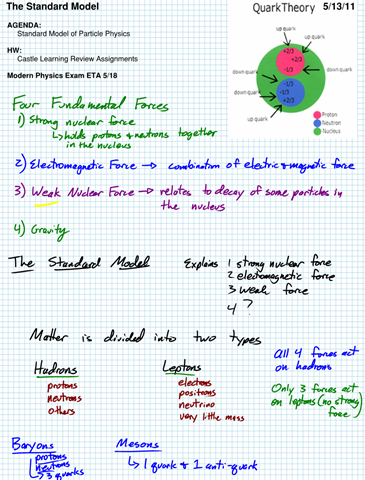
Although the Standard Model itself is a very complicated theory, the basic structure of the model is fairly straightforward.  According to the model, all matter is divided into two categories, known as hadrons and the much smaller leptons.  All of the fundamental forces act on hadrons, which include
particles such as protons and neutrons.  In contrast, the strong nuclear force doesn’t act on leptons, so only three fundamental forces act on leptons such as electrons, positrons, muons, tau particles and neutrinos.

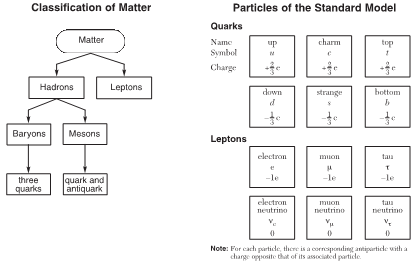
Hadrons are further divided into baryons and mesons.  Baryons such as protons and neutrons are composed of three smaller particles known as quarks.  Charges of baryons are always whole numbers.  Mesons are composed of a quark and an anti-quark (for example, an up quark and an antidown
quark).  If this sounds like a lot to keep track of, have no fear, this is summarized for you on the Regents Physics Reference Table.
image

Scientists have identified six types of quarks.  For each of the six types of quarks, there also exists a corresponding anti-quark with an opposite charge.  The quarks have rather interesting names: up quark, down quark, charm quark, strange quark, top quark, and bottom quark.  Charges on each quark are either one third of an elementary charge, or two thirds of an elementary charge, positive or negative, and the quarks are symbolized by the first letter of their name.  For the associated anti-quark, the symbol is the first letter of the anti-quark’s name, with a line over the name.  For example, the symbol for the up quark is u.  The symbol for the anti-up quark is ū.

Similarly, scientists have identified six types of leptons: the electron, the muon, the tau particle, and the electron neutrino, muon neutrino, and tau neutrino.  Again, for each of these leptons there also exists an associated anti-lepton. The most familiar lepton, the electron, has a charge of -1e.  Its anti-particle, the positron, has a charge of +1e.
Mass-Energy Equivalence

image

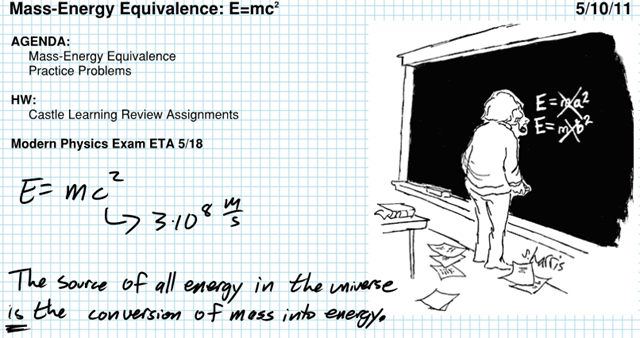
Mass and energy are two concepts effectively describing the same thing, therefore we could more appropriately combine these two laws into a single law: the law of conservation of mass-energy.  This law states that mass-energy cannot be created nor destroyed.

The universal conservation laws we have studied so far this course include:

  • Conservation of Mass-Energy
  • Conservation of Chargesmart_guy_with_emc2_hg_clr
  • Conservation of Momentum

 
Einstein’s famous formula, E=mc^2, relates the amount of energy contained in matter to the mass times the speed of light in a vacuum (c=3×10^8 m/s) squared.  Theoretically, then, we could determine the amount of energy represented by 1 kilogram of matter as follows:

image

More practically, however, it is not realistic to convert large quantities of mass completely into energy.  Current practice revolves around converting small amounts of mass into energy in nuclear processes.

Typically these masses are so small that measuring in units of kilograms is cumbersome.  Instead, scientists often work with the much smaller universal mass unit (u), which is equal in mass to one-twelfth the mass of a single atom of Carbon-12.  The mass of a proton and neutron, therefore, is close to 1u, and the mass of an electron is close to 5×10⁻⁴u.  In precise terms, 1u=1.66053886×10⁻²⁷kg.

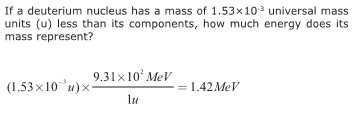
One universal mass unit (1u) completely converted to energy is equivalent to 931 MeV.  Because mass and energy are different forms of the same thing, this could even be considered a unit conversion problem.  If given a mass in universal mass units, you can use this equivalence directly from the front of the Regents Physics Reference Table to solve for the equivalent amount of energy, without having to convert into standard units and utilize the E=mc^2 equation.

image

Emission and Absorption Spectra

image

image

image

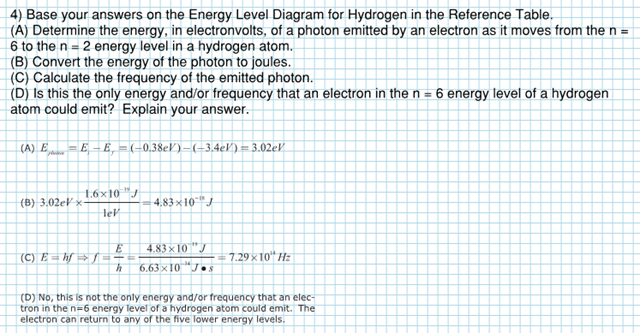
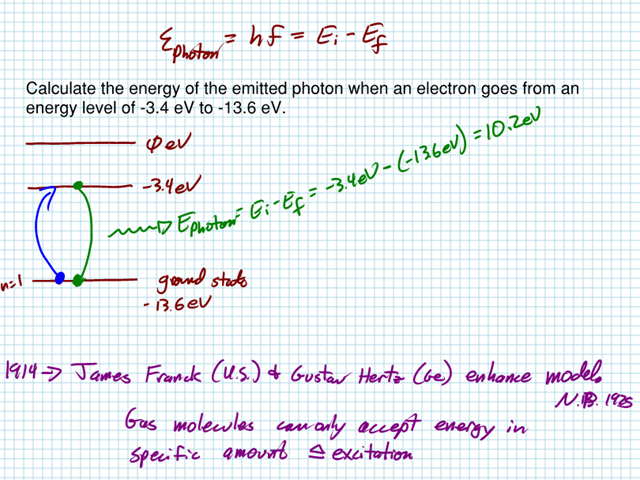
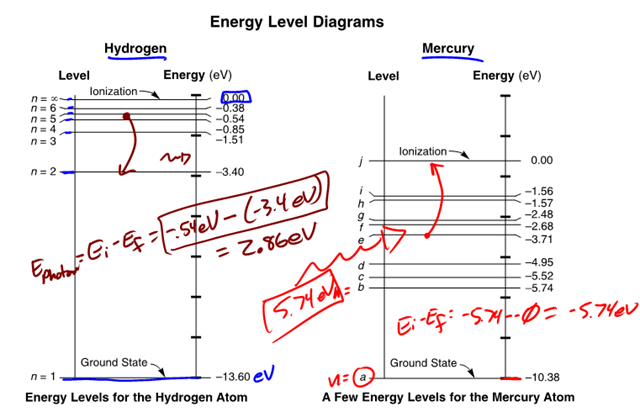
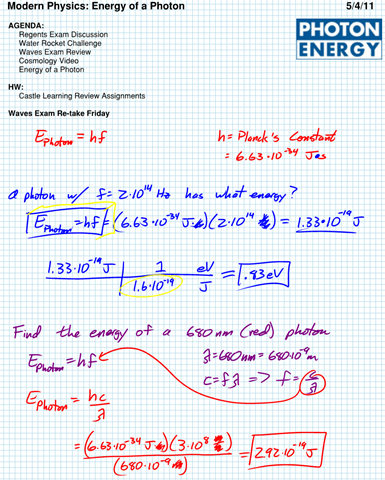
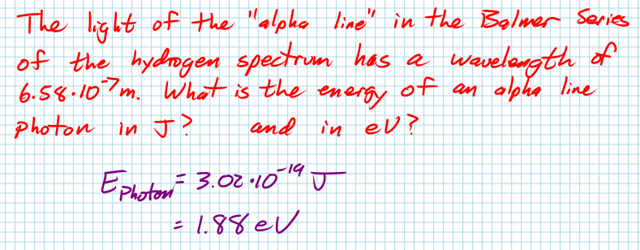
Once you understand the energy level diagram, it quickly becomes obvious that atoms can only emit certain frequencies of photons, correlating to the difference between energy levels as an electron falls from a higher energy state to a lower energy state.  In similar fashion, electrons can only absorb
photons with energy equal to the difference in energy levels as the electron jumps from a lower to a higher energy state.  This leads to unique atomic spectra of emitted radiation for each element.


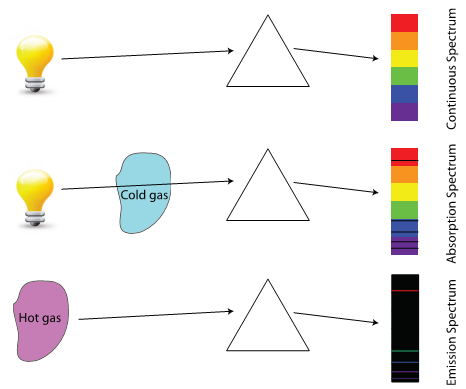
An object that is heated to the point where it glows (incandescence) emits a continuous energy spectrum, described as  blackbody radiation.

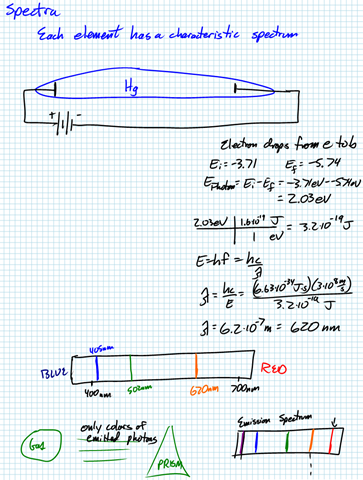
If a gas-discharge lamp is made from mercury vapor, the mercury vapor is made to emit light by application of a high electrical potential.  The light emitted by the mercury vapor is created by electrons in higher energy states falling to lower energy states, therefore the photons emitted correspond directly in wavelength to the difference in energy levels of the electrons.  This creates a unique spectrum of frequencies which can be observed by separating the colors using a prism, known as an  emission spectrum.  By analyzing the emission spectra of various objects, scientists can determine the composition of those objects.

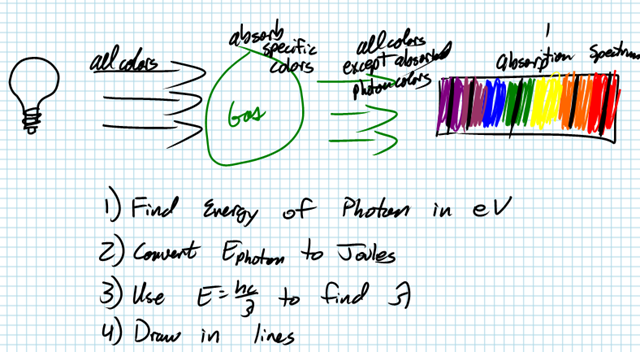
In similar fashion, if light of all colors is shone through a cold gas, the gas will only absorb the frequencies corresponding to photon energies exactly equal to the difference between the gas’s atomic energy levels.  This creates a spectrum with all colors except those absorbed by the gas, known as an  absorption spectrum.

image