Wave-Particle Duality

Although electromagnetic waves exhibit many characteristics and properties of waves, they can also exhibit some characteristics and properties of particles.  We call these “particles” photons. Because of this, we say that light (and all EM radiation) has a dual nature. At times, light acts like a wave, and at other times it acts like a particle.  Characteristics of light that indicate light behaves like a wave include:

  • Refraction
  • Diffraction
  • Interference
  • Doppler Effect

Characteristics of light that indicate light also acts as a particle include Blackbody Radiation, the Photoelectric Effect, and the Compton Effect.

Light demonstrates the characteristics of

  1. particles, only
  2. waves, only
  3. both particles and waves
  4. neither particles nor waves

A: (3) both particles and waves.

Characteristics of light that indicate light also acts as a particle include Blackbody Radiation, the Photoelectric Effect, and the Compton Effect.

Blackbody Radiation*
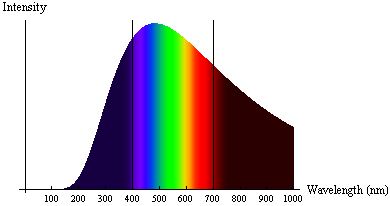
Regents Physics Blackbody Spectrum

The radiation emitted from a very hot object (known as black-body radiation) didn’t align with physicists’ understanding of light as a wave. Specifically, very hot objects emitted radiation in a specific spectrum of frequencies and intensities, which varied with the temperature of the object. Hotter objects had higher intensities at lower wavelengths (toward the blue/UV end of the spectrum), and cooler objects emitted more intensity at higher wavelengths (toward the red/infrared end of the spectrum). Physicists expected that at very short wavelengths the energy radiated would become very large, in contrast to observed spectra. This problem was known as the ultraviolet catastrophe.

German physicist Max Planck solved this puzzle by proposing that atoms could only absorb or emit radiation in specific, non-continuous amounts, known as quanta. Energy, therefore, is quantized – it only exists in specific discrete amounts. For his work, Planck was awarded the Nobel Prize in Physics in 1918.


Photoelectric Effect

Further evidence that light behaves like a particle was proposed by Albert Einstein in 1905. Scientists had observed that when EM radiation struck a piece of metal, electrons could be emitted (known as photoelectrons). What was troubling was that not all EM radiation created photoelectrons. Regardless of what intensity of light was incident upon the metal, the only variable that effected the creation of photoelectrons was the frequency of the light.
Diffraction

image

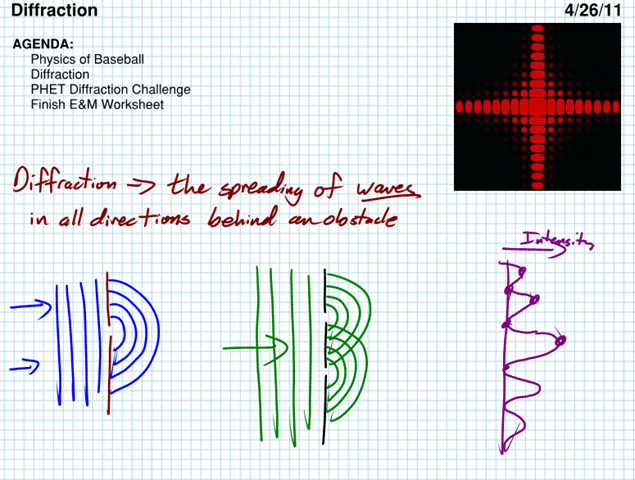
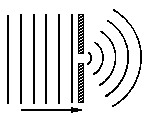
Diffraction is the bending of waves around obstacles, or the spreading of waves as they pass through an opening, most apparent when looking at obstacles or wavelengths having a size of the same order of magnitude as the wavelength. Typically, the smaller the obstacle and wavelength, the greater the diffraction. Taken to the extreme, when a wave is blocked by a small enough opening, the wave passing through the opening actually behaves like a point source for a new wave.

You can observe diffraction quite easily… I’m sure you’ve heard a noise from a room with an open door even when your ears aren’t in a direct line from the sound source… this is a result of diffraction of the sound waves around the door opening (along with some reflection of sound as well).

Thomas Young’s Double-Slit Experiment is a famous experiment which utilized diffraction to prove light has properties of waves. Young placed a single-wavelength light source behind a barrier with two narrow slits, allowing only a small portion of the light to pass through each slit. Because the two light waves travel different distances to the screen on which they are projected, you can see effects of both constructive and destructive interference, phenomena that occur only for waves!

Question: The spreading of waves into the region behind an obstacle is known as _______.

Diffraction Question

Answer: diffraction

Question: Which wave phenomenon is represented in the diagram?

Answer: diffraction

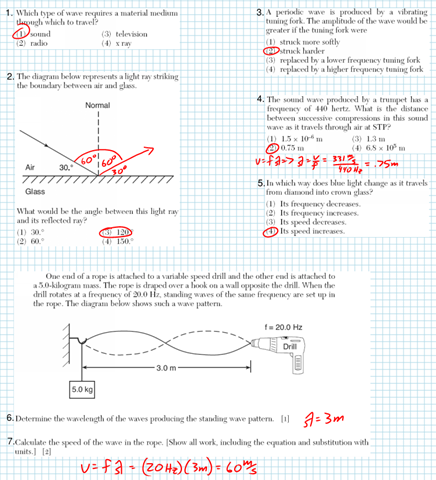
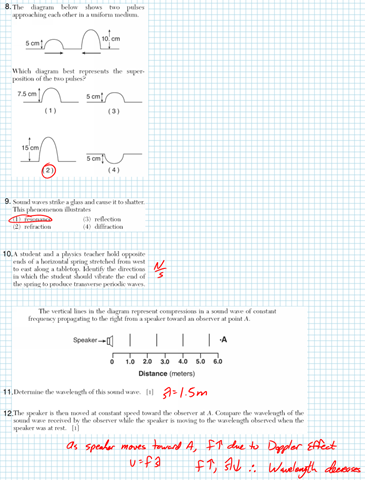
Castle Learning Review Assignments

As we prepare for our comprehensive Regents examination in June, it is important to make sure we are up to speed on material covered throughout the entire year. Toward that end, we will undertake a series of seven Castle Learning review assignments consisting of 50-60 multiple choice questions on each of the major topics we have covered this year. These topics correspond to the short review podcasts available on iTunes. I would recommend viewing the appropriate review lessons before tackling the Castle Learning assignments. Then, take the Castle Learning assignments with your reference table, the calculator you will use on the Regents exam, and your notebook handy.

Each assignment is worth 50 to 60 points, with second chance correct scores counted for full credit! These are weighty assignments, with distinct opening and closing dates. Because these are being provided well in advance of due dates, you should have opportunity to plan your time accordingly. No credit will be given for late assignments or submissions, regardless of attendance or illness issues.

Assignments and Review Schedule is as follows:

Assignment

Podcasts

Open

Close

Units Vectors Scalars

R01

4/29/2010

5/6/2010

Kinematics

R02,R03

5/6/2010

5/13/2010

Dynamics

R04,R05

5/13/2010

5/20/2010

Momentum and WEP

R06,R07,R08

5/20/2010

5/27/2010

Electricity and Magnetism

R09-R12

5/27/2010

6/3/2010

Waves and Optics

R13,R14

6/3/2010

6/8/2010

Modern Physics

R15

6/8/2010

6/14/2010

Please take these assignments seriously, and be diligent in your planning and submissions. This is a large portion of our fourth quarter grading, and is an excellent opportunity to put yourself in position for achieving an optimal score on the Regents Physics Exam!

Intro to Refraction

When a wave reaches the boundary between media, part of the wave is reflected and part of the wave enters the new medium. As the wave enters the new medium, the speed of the wave changes, and the frequency of a wave remains constant, therefore, consistent with the wave equation, Wave Equation, the wavelength of the wave must change.
Question: When a wave enters a new material, what happens to its speed, frequency, and wavelength?

Answer: Speed changes, frequency remains constant, and wavelength changes.

The front of a wave has some actual width, therefore if the wave does not impinge upon the boundary between media at a right angle, not all of the wave enters the new medium and changes speed at the same time. This causes the wave to bend as it enters a new medium in a process known as refraction.

To better illustrate this, imagine you’re in a line in a marching band, connected with your bandmates as you march at a constant speed down the field in imitation of a wave front. As your wavefront reaches a new medium that slows you down, such as a mud pit, the band members reaching the mud pit slow down before those who reach the pit later. Since you are all connected in a wave front, the entire wave shifts directions (refracts) as it passes through the boundary between field and mud!

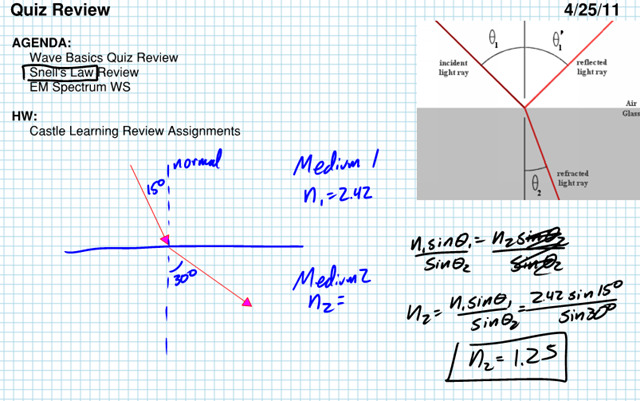
Snell's Law

The index of refraction (n) is a measure of how much light slows down in a material. In a vacuum, all electromagnetic waves have a speed of c=3*108 m/s. In other materials, light slows down. The ratio of the speed of light in a vacuum to the speed of light in the new material is known as the index of refraction (n). The slower the wave moves in the material, the larger the index of refraction: Index of Refraction

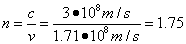
Question: A light ray traveling in air enters a second medium and its speed slows to 1.71 x 10⁸ m/s. What is the absolute index of refraction of the second medium?

Answer: IndexRSoln

Indices of Refraction

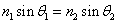
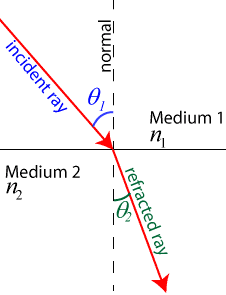
The amount a light wave bends as it enters a new medium is given by the law of refraction, also known as Snell’s Law. Snell’s Law states that Regents Physics Snell's Law, where n1 and n2 are the indices of refraction of the media, and theta corresponds to the angles of the incident and refracted rays, again measured from the normal. Light bends toward the normal as it enters a material with a higher index of refraction (slower material), and bends away from the normal as it enters a material with a lower index of refraction (slower material).
Not only does index of refraction depend upon the medium the light wave is traveling through, it also varies with frequency. Thankfully, its variation is typically fairly small, and the Regents Physics Reference Table even provides you a table of indices of refraction for common materials at a set frequency.

Snell's Law Question

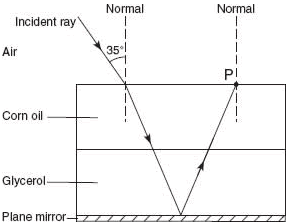
Question: A ray of monochromatic light having a frequency of 5.09 × 10¹⁴ hertz is incident on an interface of air and corn oil at an angle of 35° as shown. The ray is transmitted through parallel layers of corn oil and glycerol and is then reflected from the surface of a plane mirror, located below and parallel to the glycerol layer. The ray then emerges from the corn oil back into the air at point P.

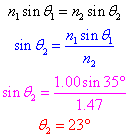
Calculate the angle of refraction of the light ray as it enters the corn oil from air.

Answer: Snell's Law Answer

Question: Explain why the ray does not bend at the corn oil-glycerol interface.

Answer: The indices of refraction are the same for corn oil and glycerol (the speed of the wave does not change at the corn-oil / glycerol interface).