
Category Archives: Kinematics
Trig and Vectors
Vector Manipulation
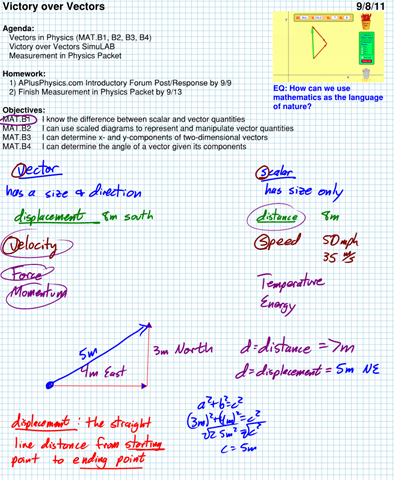
Quantities in physics are used to represent real-world measurements, and therefore physicists use these quantities as tools to better understand the world. In examining these quantities, there are times when just a number, with a unit, can completely describe a situation. These numbers, which have a magnitude, or size, only are known as scalars. Examples of scalars include quantities such as temperature, mass, and time. At other times, a quantity is more descriptive if it also includes a direction. These quantities which have both a magnitude and direction are known as vectors. Vector quantities you may be familiar with include force, velocity, and acceleration.
Most students will be familiar with scalars, but to many, vectors may be a new and confusing concept. By learning just a few rules for dealing with vectors, though, you’ll find that they are a powerful tool for problem solving.
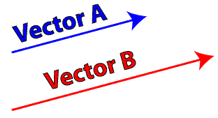
Vectors are often represented as arrows, with the length of the arrow indicating the magnitude of the quantity, and the direction of the arrow indicating the direction of the vector. In the figure at right, vector B has a magnitude greater than that of vector A. Vectors A and B point in the same direction, however. It’s also important to note that vectors can be moved anywhere in space. The positions of A and B could be reversed, and the individual vectors would retain their values of magnitude and direction. This makes adding vectors very straightforward!
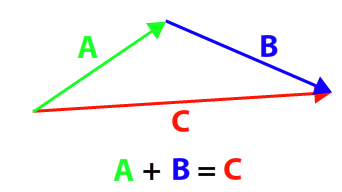 To add vectors A and B, all we have to do is line them up so that the tip of the first vector touches the tail of the second vector. Then, to find the sum of the vectors, known as the resultant, all we have to do is draw a straight line from the start of the first vector to the end of the last vector. This method works with any number of vectors.
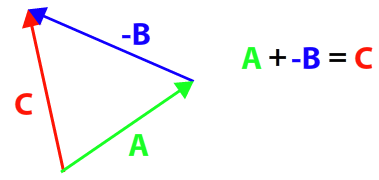
So then, how do we subtract two vectors? Let’s try it by subtracting B from A. We could rewrite the expression A – B as A + -B. Now it becomes an addition problem, we just have to figure out how to express –B. This is easier than it sounds – to find the opposite of a vector, we just point the vector in the opposite direction. Therefore, we can use what we already know about the addition of vectors to find the resultant of A–B.
Components of Vectors
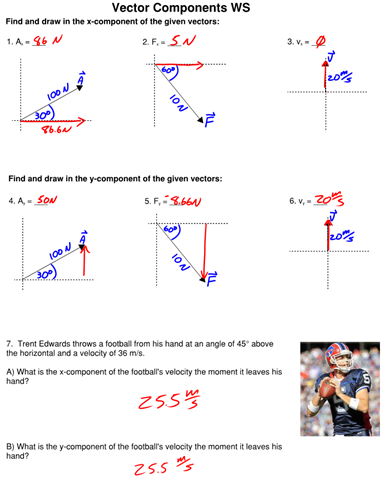
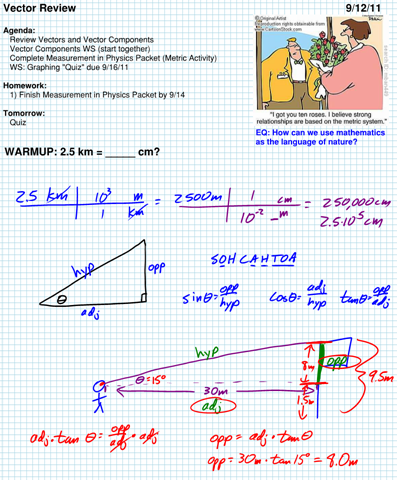
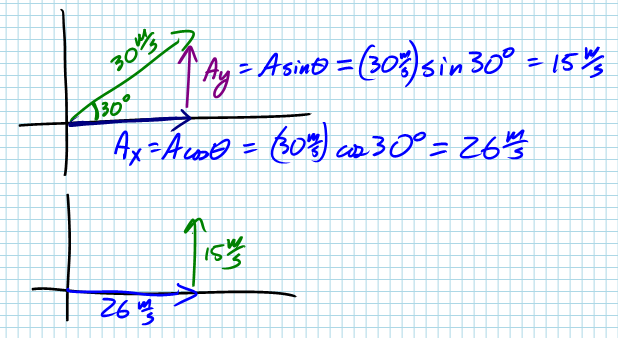
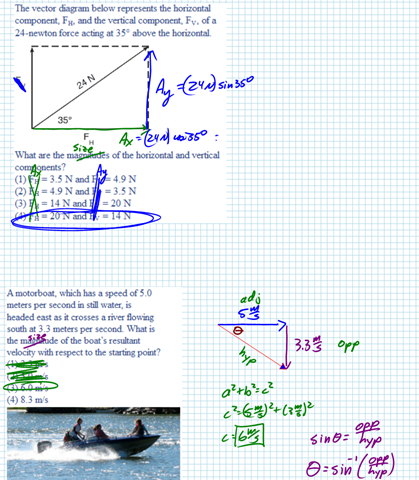
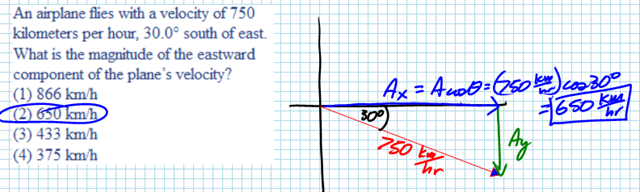
We’ll learn more about vectors as we go, but before we move on, there’s one more skill we need to learn. Vectors at angles can be challenging to deal with. By transforming a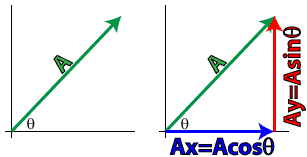 vector at an angle into two vectors, one parallel to the x-axis and one parallel to the y-axis, we can greatly simplify problem solving. To break a vector up into its components, we can use our basic trig functions. To help us out even further, the Regents Physics Reference Table includes the exact formulas we need to determine the x- and y-components of any vector if we know that vector’s magnitude and direction.
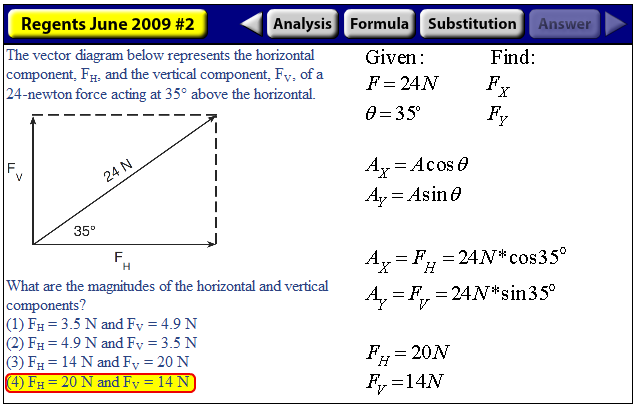
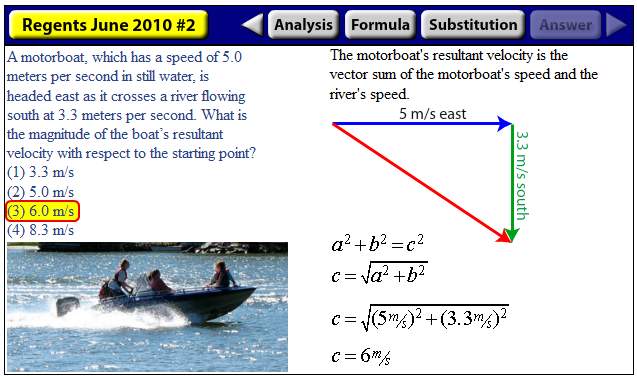
In similar fashion, we can use the components of a vector in order to build the original vector. Graphically, if we line up the component vectors tip-to-tail, the original vector runs from the starting point of the first vector to the ending point of the last vector. To determine the magnitude of the resulting vector algebraically, just apply the Pythagorean Theorem!
Intro to Vectors
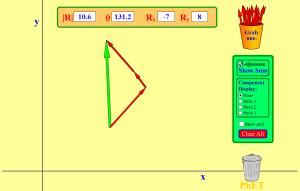
Victory over Vectors PHET Simulation
| Click to Run |
Physics of Angry Birds
Saw a comment from Frank Noschese (Action-Reaction) not long ago mentioning how cool it would be to make an Angry Birds physics motivational poster… took a couple days of fiddling with fonts and effects to get the text right, but I think I finally got a winner!
For more information, check out: Dot.Physics: The Physics of Angry Birds and Action-Reaction: Angry Birds in the Physics Classroom.
Regents Physics SBG Objective Tracking Sheets
10 Quick Tips to Maximize your Regents Physics Score
Although by no means an exhaustive list, these 10 quick tips may help you secure that extra point or two on your upcoming Regents Physics exam.
- Mass and inertia are the same thing.
- To find the resultant, line your vectors up tip-to-tail, and draw a line from the starting point of the first vector to the ending point of the last vector.
- Any object moving in a circular path is accelerating toward the center of the circle.
- Acceleration of an object is equal to the net force on the object divided by the object’s mass.
- The normal force always points at an angle of 90° from the surface.
- Opposite charges and magnetic poles attract, likes repel.
- Gravitational forces and electrostatic forces both follow an inverse square law relationship, where the strength of the force is related to one divided by the square of the distance between the charges/masses.
- The force of gravity on an object, commonly referred to as weight, is equal to mg, where g is the gravitational field strength (also referred to as the acceleration due to gravity).
- The mass-energy equivalence can be calculated using E=mc^2. If a mass is given in universal mass units, however, you can do a straight unit conversion using 1u = 931 MeV.
- Protons and neutrons fall into the category of baryons, which are hadrons. Smaller particles, such as electrons, fall into the category of leptons. Mesons are rare, weird particles you probably haven’t heard of.
Most importantly, use your reference table. When in doubt, write down the information you’re asked to find, what you’re given, and use your reference table to help you narrow down what you should be doing. In the free response part of the test, make sure to show your work in detail with a formula, substitution with units, and an answer with units.
Find these and many more tips for success at APlusPhysics.com.