
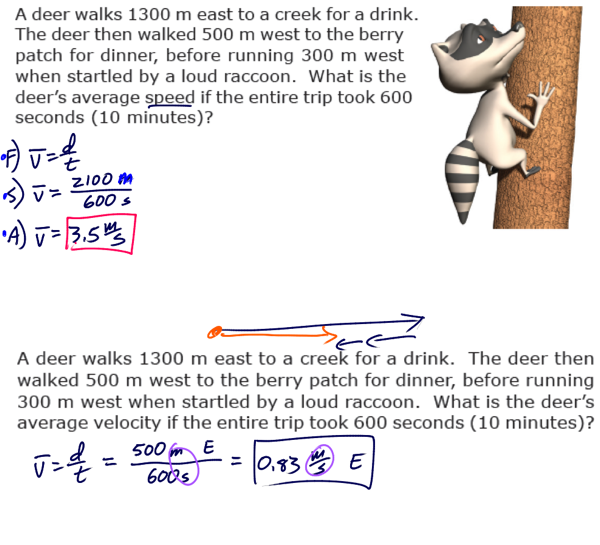
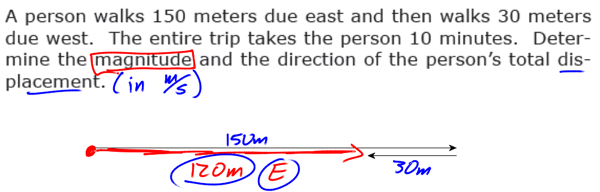
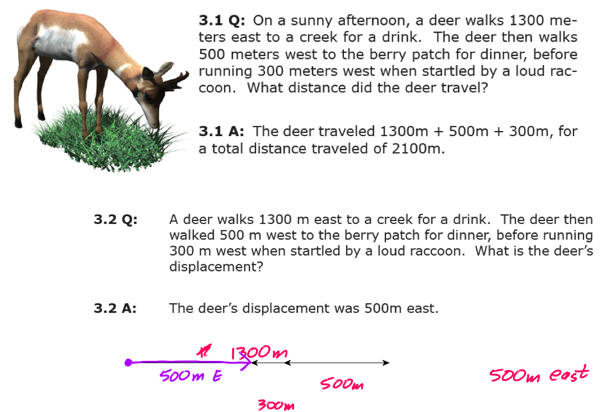
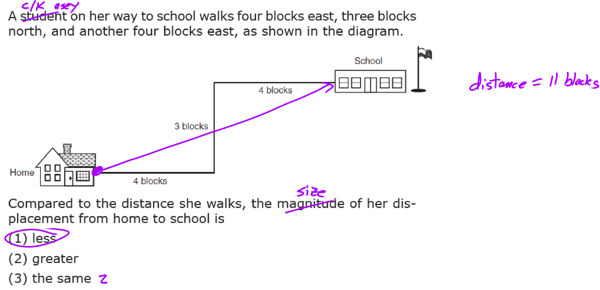
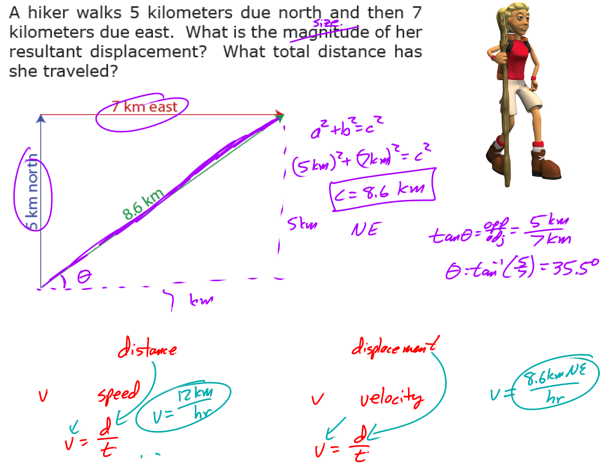
Knowing only an object’s distance and displacement doesn’t tell us the whole story. Going back to our deer example, there’s a significant difference in our picture of the deer’s afternoon if the deer’s travels occurred over 5 minutes (300 seconds) as opposed to over 50 minutes (3000 seconds).
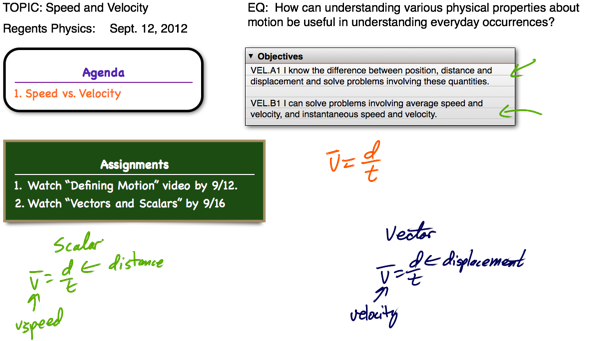
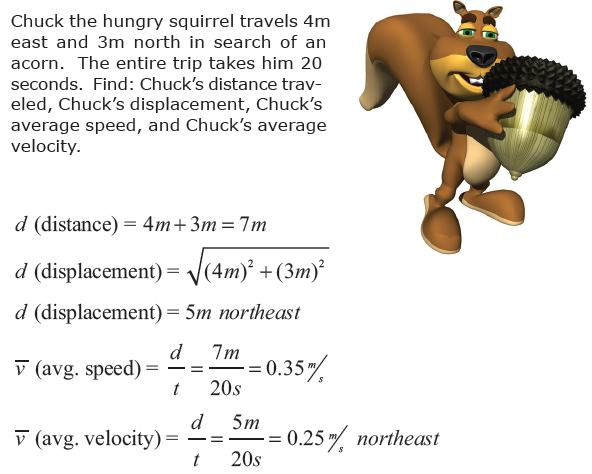
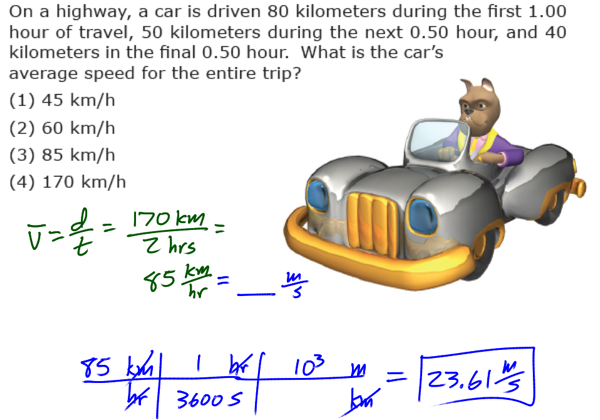
How exactly does our picture change? In order to answer that question, we’ll need to introduce some new concepts – average speed and average velocity. Both physics quantities use the same formula and the same units (m/s), but the symbols stand for different things in each formula. In this way, you can re-use the same formula to give you two different physics quantities. The formula, available on the back page of your reference table, is:

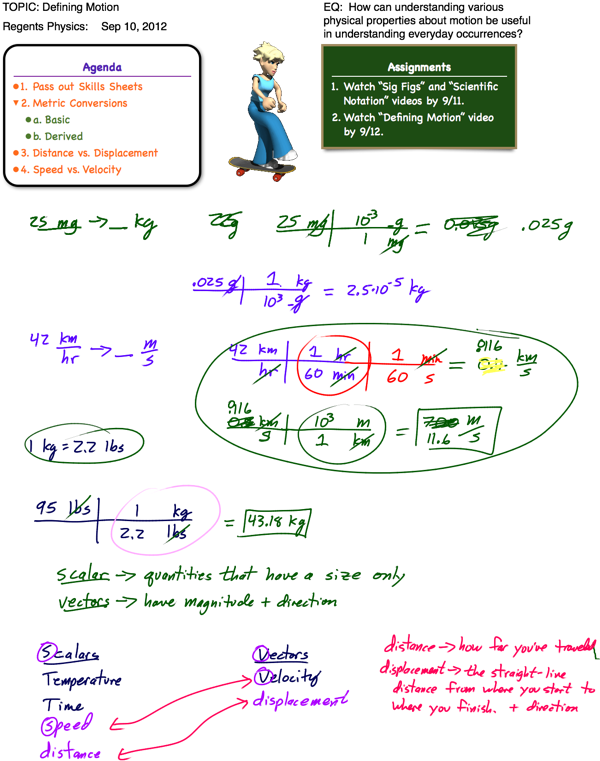
Physics involves the study, prediction, and analysis of real-world phenomena. To communicate data accurately, we must set specific standards for our basic measurements. The physics community has standarized on what is known as the Système International (SI), which defines seven baseline measurements and their standard units, forming the foundation of what is called the metric system of measurement. The SI system is oftentimes referred to as the mks system, as the three most common measurement units are meters, kilograms, and seconds, which we’ll focus on for the majority of this course. The fourth SI base unit we’ll use in this course, the ampere, will be introduced in the current electricity section.
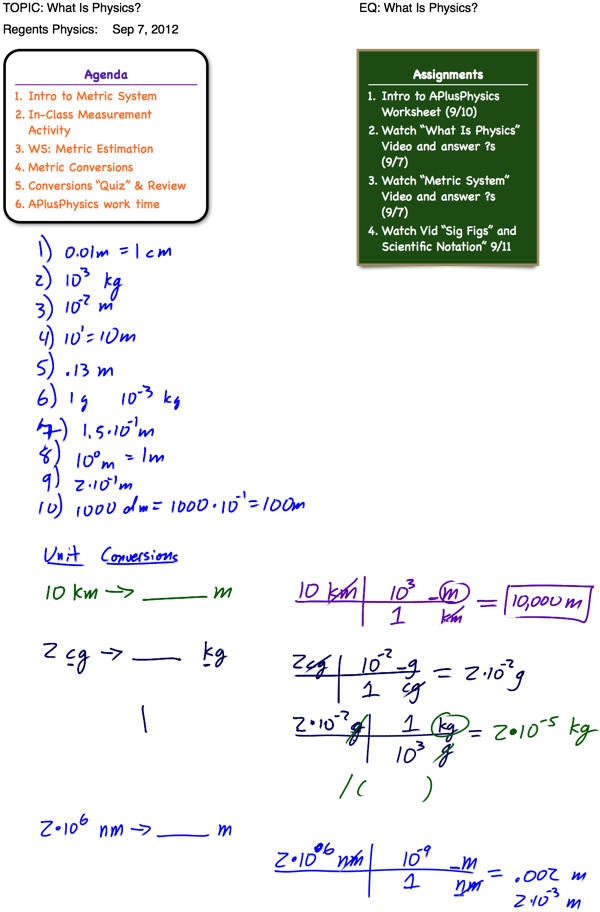
The base unit of length in the metric system, the meter, is roughly equivalent to the English yard. For smaller measurements, the meter is divided up into 100 parts, known as centimeters, and each centimeter is made up of 10 millimeters. For larger measurements, the meter is grouped into larger units of 1000 meters, known as a kilometer. The length of a baseball bat is approximately one meter, the radius of a U.S. quarter is approximately a centimeter, and the diameter of the metal in a wire paperclip is roughly one millimeter.
The base unit of mass, the kilogram, is roughly equivalent to two U.S. pounds. A cube of water 10cm x 10cm x 10cm has a mass of 1 kilogram. Kilograms can also be broken up into larger and smaller units, with commonly used measurements of grams (1/1000th of a kilogram) and milligrams (1/1000th of a gram). The mass of a textbook is approximately 2 to 3 kilograms, the mass of a baseball is approximately 145 grams, and the mass of a mosquito is 1 to 2 grams.
The base unit of time, the second, is likely already familiar. Time can also be broken up into smaller units such as milliseconds (10-3 seconds), microseconds (10-6 seconds), and nanoseconds (10-9 seconds), or grouped into larger units such as minutes (60 seconds), hours (60 minutes), days (24 hours), and years (365.25 days).
The metric system is based on powers of 10, allowing for easy conversion from one unit to another. The front page of the Physics Reference Table includes a chart showing the meaning of the commonly used metric prefixes, which can be extremely valuable in performing unit conversions.
Expectations
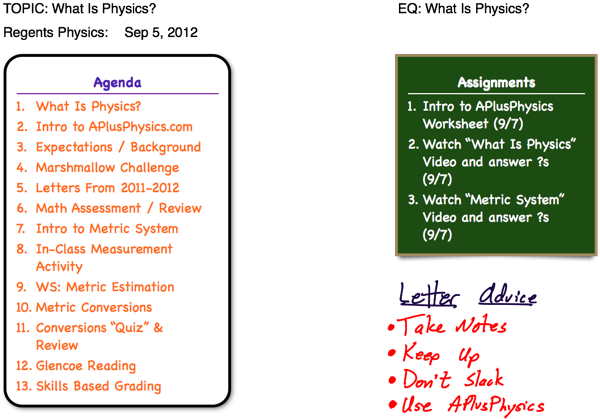
My expectations for the year are simple yet far-reaching:
The following classroom rules should also be observed:
Materials needed for this class:
Homework:
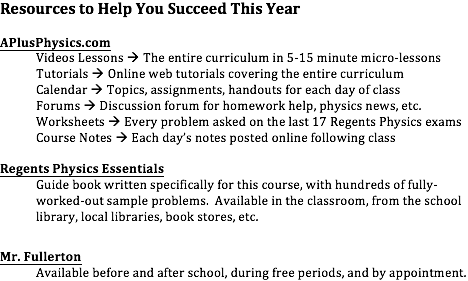
As we close in on the end of our year in high school physics, I thought it’d be helpful to myself (and perhaps to others) to put together a compendium of some of the best Regents/Honors Physics resources to assist students in preparing for their final exams. Without further ado, and in no particular order:

APlusPhysics: Dan Fullerton’s (my) site to assist students and educators specifically around the NY Regents Physics curriculum, which has been expanding and generalizing to curricula outside the state as well. The Regents Physics section of the site, however, is by far the strongest and most complete. This site includes online tutorials covering the entire Regents Physics course, interactive quizzes pulling from a database of hundreds of old Regents Physics Exam questions, video tutorials of every major topic covered by the exam, and is also tied in quite closely with the Regents Physics Essentials review book. In addition, every Regents Physics questions from the past 16 exams has been pulled into worksheets by topic to allow for highly directed practice.
ScienceWithMrNoon: Brendan Noon‘s physics site has a wide variety of great content, including topic-based interactive quizzes and tons of great physics videos. His course calendar, as well, is loaded with tons of great resources by topic!
St. Mary’s Physics: Tony Mangiacapre‘s site, full of great lessons and interactive simulations across the entire Regents Physics curriculum. I’m especially fond of the Photoelectric Effect simulation — makes for a great computer-based lab activity! This site is also closely linked with Tony’s 123physics.com, featuring more than 1300 Regents Physics Exam questions broken down by topic for students to practice, as well as more great videos.
RegentsPrep.org: The Oswego City School District (with Dr. Tom Altman) has pulled together a strong collection of resources broken into Explanations, Demos, Labs, and Quizzes to assist students and educators in preparing for the Regents Physics exam.
Altman Science: The charismatic Dr. Tom Altman provides real-life demonstrations and explanations of physics concepts in action as part of the High School Physics Project. Further, he’s broken down a number of old Regents Exams and walked through solutions to each and every question in video format, page by page. In addition, his laser videos are “wicked cool” as well!
Past Regents Exams: The name says it all — an amazing archive of old Regents Physics exams!
Regents Physics Essentials: I’d feel negligent if I didn’t point out the Regents Physics Essentials review book I put together at student urging a few years back. There are a number of great review books to help students get ready for the exam, but this book takes a slightly different twist by providing students a straightforward, clear explanation of the fundamental concepts and more than 500 sample questions with fully-worked out solutions directly integrated in the text. As stated by my physics teaching cohort in crime at our high school, “the best review book is the one students will actually use,” and this was written to be friendly, fun, and concise. Plus, if students/teachers want extra problems without solutions given, the worksheets are available free online! You can check out the book’s free preview on APlusPhysics or use Amazon’s “Look Inside” feature!