Electrical charges can move easily in some materials (conductors) and less freely in others (insulators), as we learned previously. We describe a material’s ability to conduct electric charge as conductivity. Good conductors have high conductivities. The conductivity of a material depends on:
In similar fashion, we describe a material’s ability to resist the movement of electric charge using resistivity, symbolized with the Greek letter rho ( ). Resistivity is measured in ohm-meters, which are represented by the Greek letter omega multiplied by meters (
 •m). Both conductivity and resistivity are properties of a material.

When an object is created out of a material, the material’s tendency to conduct electricity, or conductance, depends on the material’s conductivity as well as the material’s shape. For example, a hollow cylindrical pipe has a higher conductivity of water than a cylindrical pipe filled with cotton. However, shape of the pipe also plays a role. A very thick but short pipe can conduct lots of water, yet a very narrow, very long pipe can’t conduct as much water. Both geometry of the object and the object’s composition influence its conductance.
Focusing on an object’s ability to resist the flow of electrical charge, we find that objects made of high resistivity materials tend to impede electrical current flow and have a high resistance. Further, materials shaped into long, thin objects also increase an object’s electrical resistance. Finally, objects typically exhibit higher resistivities at higher temperatures. We take all of these factors together to describe an object’s resistance to the flow of electrical charge. Resistance is a functional property of an object that describes the object’s ability to impede the flow of charge through it. Units of resistance are ohms ().
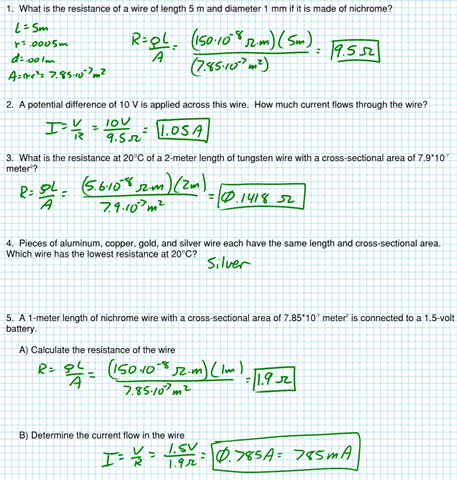
For any given temperature, we can calculate an object’s electrical resistance, in ohms, using the following formula, which can be found on your reference table.
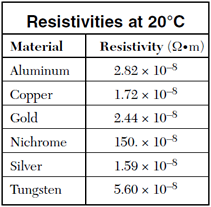

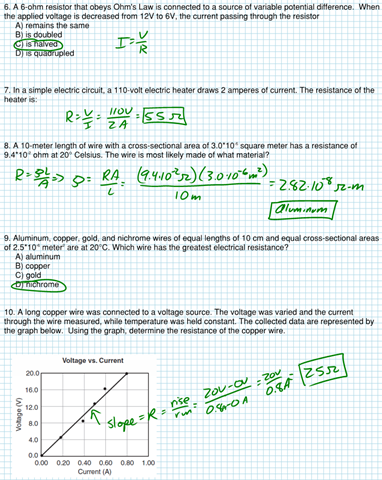
In this formula, R is the resistance of the object, in ohms (), rho () is the resistivity of the material the object is made out of, in ohm*meters (•m), L is the length of the object, in meters, and A is the cross-sectional area of the object, in meters squared. Note that a table of material resistivities for a constant temperature is given to you on the reference table!
Let’s try a sample problem calculating the electrical resistance of an object:
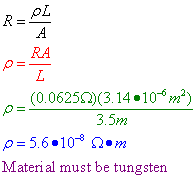
Question: A 3.50-meter length of wire with a cross-sectional
area of 3.14 × 10⁻⁶ m2 at 20° Celsius has a resistance of 0.0625Answer:
Agenda:
If resistance opposes current flow, and potential difference promotes current flow, it only makes sense that these quantities must somehow be related. George Ohm studied and quantified these relationships for conductors and resistors in a famous formula now known as Ohm’s Law:

Ohm’s Law may make more qualitative sense if we re-arrange it slightly:

Now it’s easy to see that the current flowing through a conductor or resistor (in amps) is equal to the potential difference across the object (in volts) divided by the resistance of the object (in ohms). If you want a large current to flow, you would require a large potential difference (such as a large battery), and/or a very small resistance.
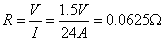
Question: The current in a wire is 24 amperes when connected to a 1.5 volt battery. Find the resistance of the wire.
Answer:
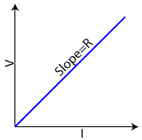
Note: Ohm’s Law isn’t truly a law of physics — not all materials obey this relationship. It is, however, a very useful empirical relationship that accurately describes key electrical characteristics of conductors and resistors. One way to test if a material is ohmic (if it follows Ohm’s Law) is to graph the voltage vs. current flow through the material. If the material obeys Ohm’s Law, you’ll get a linear relationship, and the slope of the line is equal to the material’s resistance.
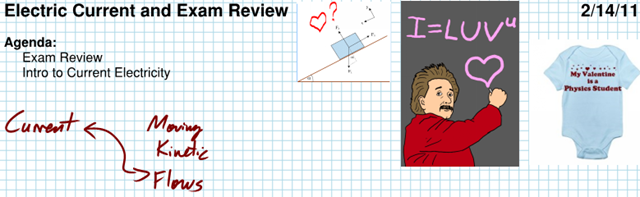

Electric current is the flow of charge, much like water currents are the flow of water molecules. Water molecules tend to flow from areas of high gravitational potential energy to low gravitational potential energy. Electric currents flow from high electric potential to low electric potential. And the greater the difference between the high and low potential, the more current that flows!
In a majority of electric currents, the moving charges are negative electrons. However, due to historical reasons dating back to Ben Franklin, we say that conventional current flows in the direction positive charges would move. Although inconvenient, it’s fairly easy to keep straight if you just remember that the actual moving charges, the electrons, flow in a direction opposite that of the electric current. With this in mind, we can state that positive current flows from high potential to low potential, even though the charge carriers (electrons) actually flow from low to high potential.
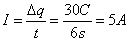
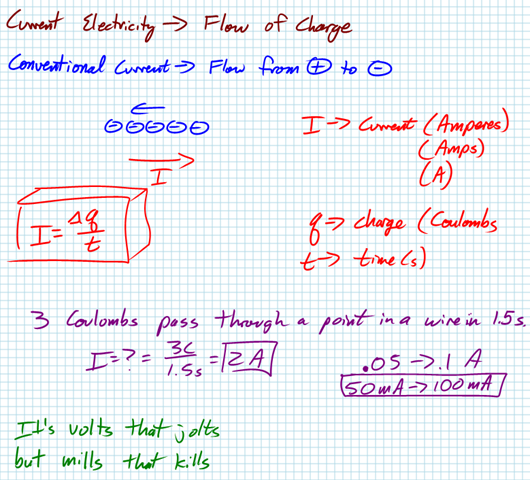
Electric current (I) is measured in amperes (A), or amps, and can be calculated by finding the total amount of charge ( q), in Coulombs, which passes a specific point in a given time (t). Electric current can therefore be calculated as:

Question: A charge of 30 Coulombs passes through a 24-ohm resistor in 6.0 seconds. What is the current through the resistor?
Answer:
Electrical charges can move easily in some materials (conductors) and less freely in others (insulators), as we learned previously. We describe a material’s ability to conduct electric charge as conductivity. Good conductors have high conductivities. In similar fashion, we describe a material’s ability to resist the movement of electric charge using resistivity, symbolized with the Greek letter rho (). Resistivity is measured in ohm-meters, which are represented by the Greek letter omega multiplied by meters (•m). Both conductivity and resistivity are properties of a material.
Ball Lightning Sample:
 For the tenth year in a row teachers, administrators, and staff from Webster Thomas High School and West Irondequoit High School will compete in a basketball game remembering Adam Milne to raise money for the Leukemia Lymphoma Society. The game is scheduled for Friday, March 4, at 7 p.m. at Irondequoit High School.
Adam was a social studies teacher at Irondequoit High School who was married to a teacher from Webster for three months, until he passed away of leukemia. Adam made a profound impact on his students and colleagues, living his motto, “Go Forth and Spread Joy.”
Like most charity basketball games, you’ll find quite a mix of talented, experienced, athletic players, along with plenty of us uncoordinated rookies who run around in circles, have fun, and are just proud if the ball hits the backboard!
You can help by coming to the game, sponsoring a player, or making a donation to this worthy cause in a fun and exciting event. Tickets will be sold only at the door on a first come, first served basis. There will be 600 gym tickets sold, $5 for students and $7 for adults. For any more than 600 people arrangements are being looked into sell additional seats in the auditorium to view a live feed. If feasible, those tickets would be $2.
Personal and/or corporate donations may be made by contacting Lou DiCesare at Louis_DiCesare@westiron.monroe.edu.)
Agenda:
Review HW: Charges, Fields and Potential
Video: Electrostatics Review
HANDOUT: Cartoon Charges
HW: Charges, Fields and Potential Packet (due 2/11) –> Solutions below
EXAM: P1, 4, 7 on Friday P8/9 on Thursday