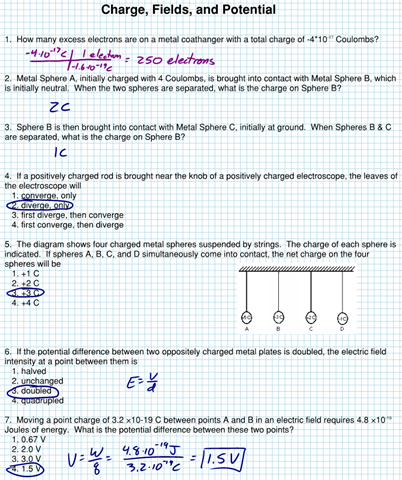
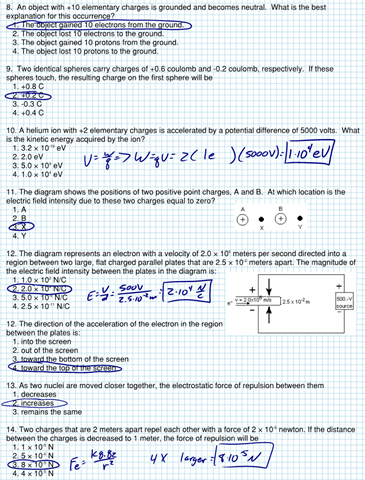
Reminder: P1, 4, 7 Exam 2/11; P9 Exam 2/10
When we lifted an object against the force of gravity by applying a force over a distance, we did work to give that object gravitational potential energy. The same concept applies to electric fields as well. If you move a charge against an electric field, you must apply a force for some distance, therefore you do work and give it electrical potential energy. The work done per unit charge in moving a charge between two points in an electric field is known as the electric potential difference, (V). The units of electric potential are volts, where a volt is equal to 1 Joule per Coulomb. Therefore, if you did 1 Joule of work in moving a charge of 1 Coulomb in an electric field, the electric potential difference between those points would be 1 volt. This is given to you in the reference table as:

V in this formula is potential difference (in volts), W is work or electrical energy (in Joules), and q is your charge (in Coulombs). Let’s take a look at a sample problem.
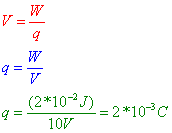
Question: A potential difference of 10.0 volts exists between two points, A and B, within an electric field. What is the magnitude of charge that requires 2.0 × 10⁻² joule of work to move it from A to B?
Answer:
When dealing with electrostatics, often times the amount of electric energy or work done on a charge is a very small portion of a Joule. Dealing with such small numbers is cumbersome, so physicists devised an alternate unit for electrical energy and work that can be more convenient than the Joule. This unit, known as the electron-volt (eV), is the amount of work done in moving an elementary charge through a potential difference of 1V. One electron-volt, therefore, is equivalent to one volt multiplied by one elementary charge (in Coulombs): 1 eV = 1.6*10-19 Joules.
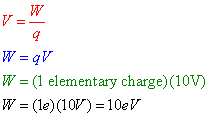
Question: A charge of 2*10-3 C is moved through a potential difference of 10 volts in an electric field. How much work, in electron-volts, was required to move this charge?
Answer:
If you know the potential difference between two parallel plates, you can easily calculate the electric field strength between the plates. As long as you’re not near the edge of the plates, the electric field is constant between the plates, and its strength is given by:

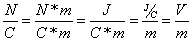
You’ll note that with the potential difference V in volts, and the distance between the plates in meters, units for the electric field strength are volts per meter [V/m]. Previously, we stated that the units for electric field strength were newtons per Coulomb [N/C]. It is easy to show that these units are equivalent:
Question: Which electrical unit is equivalent to one joule?
- volt / meter
- ampere * volt
- volt / Coulomb
- Coulomb*volt
Answer: (4) Coulomb*volt
Let’s try another sample problem:
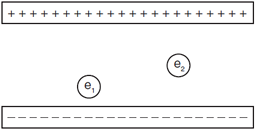
Question: The diagram represents two electrons, e1 and e2, located between two oppositely charged parallel plates. Compare the magnitude of the force exerted by the electric field on e1 to the magnitude of the force exerted by the electric field on e2.
Answer: The force is the same because the electric field is the same for both charges, as the electric field is constant between two parallel plates.
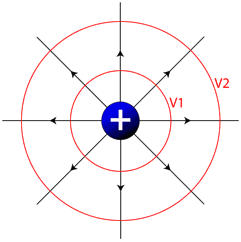
Much like looking at a topographic map which shows you lines of equal altitude, or equal gravitational potential energy, we can make a map of the electric field and connect points of equal electrical potential. These lines, known as equipotential lines, always cross electrical field lines at right angles, and show positions in space with constant electrical potential. If you move a charged particle in space, and it always stays on an equipotential line, no work will be done.
Mid-Term results have been compiled and published. In general, scores are right in line with performance within the last few years. The exam itself was styled after the Regents Exam which is given at the end of the school year, and included topics from all aspects of Newtonian Mechanics (roughly half of the Regents Exam). This included 46 multiple choice questions, and 25 open-ended, or “free response,” type questions. Students were given 180 minutes to complete the exam, as well as a formula sheet (Regents Physics Reference Table), and a ruler. Students were permitted the use of a scientific calculator.
Summary Data
Summary data from this year’s exam, along with the previous two years of data, are shown at right. 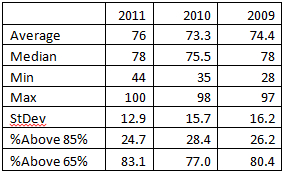 Average score on the exam, with a fairly generous curve, was 76%, compared to 73% in 2010 and 74% in 2009. Median score was 78%, two points higher than last year’s exam, and right in line with 2009 scores. Percentage of students scoring above 85%, considered “Mastery Level” by Regents Physics standards, was 25%, slightly lower than in 2010 and 2009, but passing percentage was 83%, several points higher than in past years. Even more promising is a glance at a histogram
  breaking down student scores further. This data indicates that we have many students in the 80-85% range. Past history has shown me that it is quite possible for students to improve their scores from 10-15% points between now and the actual Regents Exam in June with focused effort, study, and motivation. This indicates the potential for outstanding standardized exam performance in June if students buckle down and focus their efforts. Unfortunately, the Physics Regents Exam is usually one of the last tests offered (sometimes even after official graduation), so obtaining and maintaining student focus at this point of the year can be a challenge.
Cluster Data
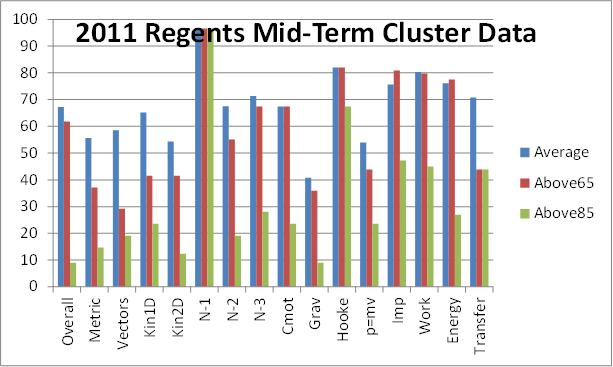
Breaking down exam performance by topic, we observe students demonstrating a very strong understanding of Newton’s Laws of Motion, Hooke’s Law (springs), and Work and Energy. These have been focus areas during the year, although there is room for further improvement in understanding Newton’s 2nd Law as well as momentum and impulse.
Cluster data indicates weaknesses in Newton’s Law of Universal Gravitation, although a deeper look at the questions and errors themselves indicates that most of the confusion here is a result of mathematical errors rather than conceptual misunderstandings. This is being re-emphasized as we work through Coulomb’s Law / Electrical Force problems, which utilize almost the exact same mathematical model. Other areas for improvement include 2-D Kinematics (projectile motion), a perennial challenge, and utilizing and understanding the metric system, a topic that has been emphasized and will continue to be reviewed throughout the year. Performance on momentum problems was, unsurprisingly, problematic. This relates directly to a “class as a whole” issue with independent practice and motivation throughout that unit, and will be our top priority for review in mid-June.

Conclusions
Student performance is in line with, if not slightly above, expectations for this point in the year. With a focused effort, students can fairly routinely increase their scores 10 to 15 percentage points by June. For struggling students, a variety of remediation protocols are being put in place, including the entire course content and sample quizzes available on the web, tailored directly to this course’s requirements (APlusPhysics.com), video lectures on topics corresponding directly to our textbook (Hippocampus), and even review sessions which can be viewed from any computer supporting iTunes (Windows, Mac, Linux, etc.) as well as iPods, iPhones, Blackberries, Android devices, etc. All of these resources are available both in the classroom as well as the school library for those who don’t have ready access to these resources outside of school.
Data has also been broken down to the same level for individual students, and will be utilized to develop both entire-class and individual review plans to allow students to focus on areas that will provide the biggest “bang for the buck” in their studies.
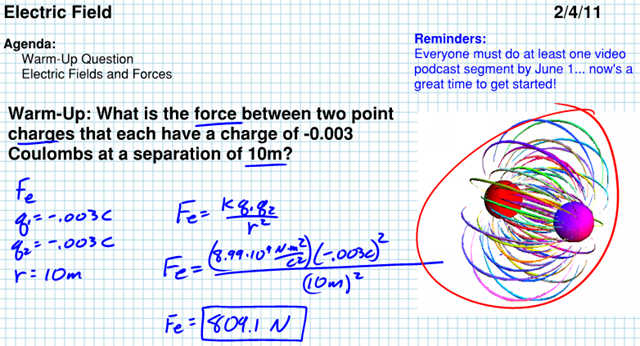
Notes: Electrostatics Exam for P1, 4, 7 on 2/11; Exam for P8/9 on 2/10.
Also similar to gravity, the electrostatic force is a non-contact force. Charged objects do not have to be in contact with each other to exert a force on each other. Somehow, a charged object feels the effect of another charged object through space. The property of space that allows a charged object to feel a force is a concept called electric field. Although we cannot see an electric field, we can detect its presence by placing a positive test charge at various points in space and measuring the force the test charge feels.
While looking at gravity, the gravitational field strength was the amount of force obsered by a mass per unit mass. The electric field strength is the amount of electrostatic force observed by a charge per unit charge. Therefore, the electric field strength, E, is the electrostatic force observed at a given point in space divided by the test charge itself. Electric field strength is measured in Newtons per Coulomb (N/C).

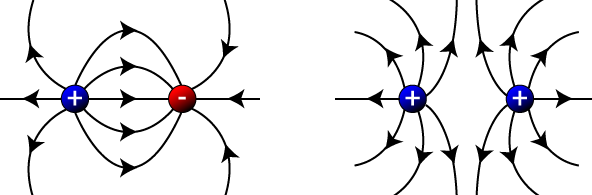
Since we can’t actually see the electric field, we can draw electric field lines to help us visualize the force a charge would feel if placed at a specific position in space. To help us visualize the electric field, we can draw electric field lines in space. These lines show the direction a positive charged particle would feel a force if it were placed at that point in space. The more dense the lines are, the stronger the force a charged particle would feel, therefore the stronger the electric field. As the lines get further apart, the strength of the electric force a charged particle would feel is smaller, therefore the electric field is smaller.
By convention, we draw electric field lines showing the direction of force on a positive charge. Therefore, to draw electric field lines for a system of charges, follow these basic rules:
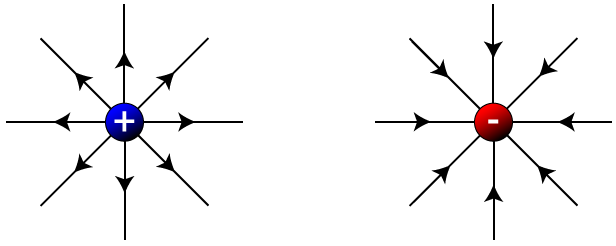
Let’s take a look at a few examples of electric field lines, starting with isolated positive (left) and negative (right) charges. Notice that for each charge, the lines radiate outward or inward spherically. The lines point away from the positive charge, since a positive test charge placed in the field (near the fixed charge) would feel a repelling force. The lines point in toward the negative fixed charge, since a positive test charge would feel an attractive force.
If you have both positive and negative charges in close proximity, you follow the same basic procedure:
Because gravity and electrostatics have so many similarities, let’s take a minute to do a quick comparison of electrostatics and gravity.
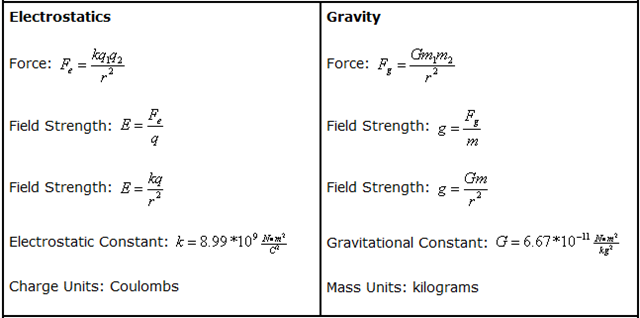
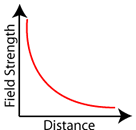
The big difference between electrostatics and gravity? The gravitational force can only attract, while the electrostatic force can both attract and repel. Notice again that both the electric field strength and the gravitational field strength follow the inverse-square law relationship. Field strength is inversely related to the square of the distance.
Introduction
 The work electricity comes from the Greek word elektron, which means "amber." Amber is a petrified tree resin, and the ancient Greeks understand that if you rub an amber rod with a piece of cloth, the amber attracts small pieces of leaves or dust. A piece of hard rubber, a glass rod, or a plastic ruler rubbed with a cloth can also display this "amber effect," which we know as static electricity.
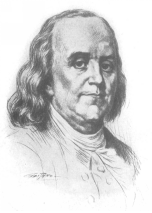
Two types of electric charge exist, as determined by Benjamin Franklin in the 1700s. Franklin labeled these charges "positive" and "negative." He also found that the charges either attract each other, or repel each other. Detailed experiments showed that unlike charges attract, and like charges repel.
Franklin also determined that, in generating any amount of charge, the amount of charge generated on the rod was equal to the amount of opposite charge generated by the cloth. Stated more clearly in the law of conservation of electric charge: "the net amount of electric charge produced in any process is zero."
Precautions in Using the Charge Sensor
Modern synthetic shoes, fabrics, and plastic insulators readily accumulate stray static charges under moderately dry conditions, so care must be taken that the charges measured are those in the experiment, not those on the experimenter. Three simple precautions help:
Experimental Setup

Detecting Charge by Induction
Analyzing the Electroscope
Experiments with Charged Tape
Deliverables
Carefully answer all questions and requests proposed in this lab report on a separate sheet of paper with your name and period at the top. Each class member must turn in their own paper. This will require you to read the entire set of directions in detail.
Your paper should have three sections:
Place your neatly completed sheet in the Inbox.
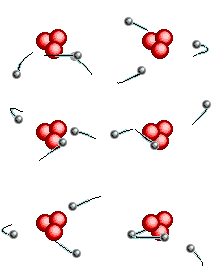
Matter is made up of atoms. Once thought to be the smallest building blocks of matter, we now know that atoms can be broken up into even smaller pieces, known as protons, electrons, and neutrons. Each atom consists of a dense core of positively charged protons and uncharged (neutral) neutrons. This core is known as the nucleus. It is surrounded by a “cloud” of much smaller, negatively charged electrons. These electrons orbit the nucleus in distinct energy levels. To move to a higher energy level, an electron must absorb energy. When an electron falls to a lower energy level, it gives off energy.
Most atoms are neutral — that is, they have an equal number of positive and negative charges, giving a net charge of 0. For this to occur, the number of protons must equal the number of electrons. In certain situations, however, an atom may gain or lose electrons. In these cases, the atom as a whole is no longer neutral, and we call it an ion. If an atom loses one or more electrons, it has a net positive charge, and is known as a positive ion. If, instead, an atom gains one or more electrons, it has a net negative charge, and is therefore called a negative ion. Like charges repel each other, while opposite charges attract each other. In physics, we represent the charge on an object with the symbol q.
Charge is a fundamental measurement in physics, much as length, time, and mass are fundamental measurements. The fundamental unit of charge is the Coulomb [C], which is a very large amount of charge. Compare that to the magnitude of charge on a single proton or electron, known as an elementary charge, which is equal to 1.6*10^-19 coulomb. It would take 6.25*10^18 elementary charges to make up a single coulomb of charge! (Don’t worry about memorizing these values, they’re listed for you on the front of the reference table!).
Question: An object possessing an excess of 6.0*10^6 electrons has what net charge?
Answer:
Certain materials allow electric charges to move freely. These are called conductors. Examples of good conductors include metals such as gold, copper, silver, and aluminum. In contrast, materials in which electric charges cannot move freely are known as insulators. Good insulators include materials such as glass, plastic, and rubber.
Conductors and insulators are characterized by their resistivity, or ability to resist movement of charge. Materials with high resistivities are good insulators. Materials with low resistivities are good conductors.
Semiconductors are materials which, in pure form, are good insulators. However, by adding small amounts of impurities known as dopants, their resistivities can be lowered significantly until they become good conductors.
Materials can be charged by contact, or conduction. If you take a balloon and rub it against your hair, some of the electrons from the atoms in your hair are transferred to the balloon. The balloon now has extra electrons, and therefore has a net negative charge. Your hair has a deficiency of electrons, therefore it now has a net positive charge.
Much like momentum and energy, charge is also conserved. Continuing our hair and balloon example, the magnitude of the net positive charge on your hair is equal to the magnitude of the net negative charge on the balloon. The total charge of the hair/balloon system remains zero (neutral). For every extra electron (negative charge) on the balloon, there is a corresponding missing electron (positive charge) in your hair. This known as the law of conservation of charge.
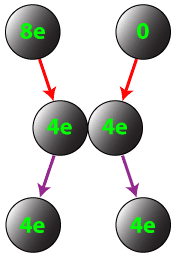
Conductors can also be charged by contact. If a charged conductor is brought into conduct with an identical neutral conductor, the net charge will be shared across the two conductors.
Question: If a conductor carrying a net charge of 8 elementary charges is brought into contact with an identical conductor with no net charge, what will be the charge on each conductor after they are separated?
Answer: Each conductor will have a charge of 4 elementary charges.
Question: What is the net charge (in coulombs) on each conductor after they are separated?
Answer:
We know that like charges repel, and opposite charges attract. In order for charges to repel or attract, they apply a force upon each either. Similar to the manner in which the force of attraction between two masses is determined by the amount of mass and the distance between the masses, as described by Newton’s Law of Universal Gravitation, the force of attraction or repulsion is determined by the amount of charge and the distance between the charges. The magnitude of the electrostatic force is described by Coulomb’s Law.
Coulomb’s Law states that the magnitude of the electrostatic force (Fe) between two objects is equal to a constant, k, multiplied by each of the two charges, q1 and q2, and divided by the square of the distance between the charges (r2). The constant k is known as the electrostatic constant, and is given on the reference table as: 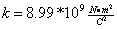 .
.

Notice how similar this formula is to the formula for the gravitational force! Both Newton’s Law of Universal Gravitation and Coulomb’s Law follow the inverse-square relationship, a pattern that repeats many times over in physics. The further you get from the charges, the weaker the electrostatic force. If you were to double the distance from a charge, you would quarter the electrostatic force on a charge.
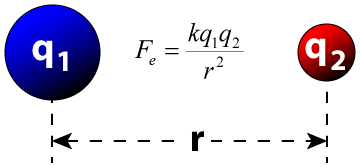
Formally, a positive value for the electrostatic force indicates that the force is a repelling force, while a negative value for the electrostatic force indicates that the force is an attractive force. Because force is a vector, you must assign a direction to it. To determine the direction of the force vector, once you have calculated its magnitude, use common sense to tell you the direction on each charged object. If the objects have opposite charges, they are being attracted, and if they have like charges, they must be repelling each other.
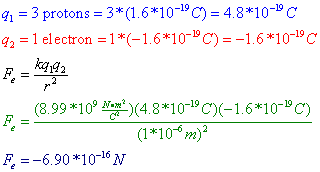
Question: Three protons are separated from a single electron by a distance of 1*10^-6 m. Find the electrostatic force between them. Is this force attractive or repulsive?
Answer: