
Search the Community
Showing results for tags 'ap physics 1'.
Found 19 results
-
In the following diagram, a force F acts on a cart in motion on a frictionless surface. The initial and final velocities of each cart are shown. Rank the energy required to change each cart's velocity from greatest to least. A: Weighs 2 kg, 5 m/s to 2 m/s - Change in KE = 1/2*2*(2*2-5*5) J = -21 J B: Weighs 3 kg, 3 m/s to -3 m/s - Change in KE = 1/2*3*(3*3-(-3)*(-3)) J = 0 J C: Weighs 5 kg, 5 m/s to 6 m/s - Change in KE = 1/2*5*(6*6-5*5) J = 27.5 J D: Weighs 4 kg, -1 m/s to 2 m/s - Change in KE = 1/2*4*(2*2-(-1)*(-1)) J = 6 J The answer says that the ranking is C, B, A, D, which doesn't make any sense to me given the calculations I made. Can someone please explain what I did wrong, or clarify the question?
-
I am confused about problem number seven part b in this pdf. http://aplusphysics.com/ap1/Problems/AP1 Momentum.pdf I read the given answer, and I am still confused. I don't know how you are supposed to get 0 m/s for the velocity of the block. Why do you use negative impulse for the block when you use positive impulse for the sphere? When do you use negative impulse? Why don't you use the mass of the entire system, which would be the block and the ball? This has to do with it being elastic/inelastic, but I don't know how you can tell from an impulse graph. Help??
-
 Name: AP Physics 1 2017 Free Response Solutions Category: Exam Prep Date Added: 2017-08-20 Submitter: FizziksGuy Walk-through of the 2017 AP Physics 1 Free Response Questions. Questions can be found at https://secure-media.collegeboard.org...For more information, please visit http://aplusphysics.com*AP and Advanced Placement Program are registered trademarks of the College Board, which does not sponsor or endorse this work. AP Physics 1 2017 Free Response Solutions
 -
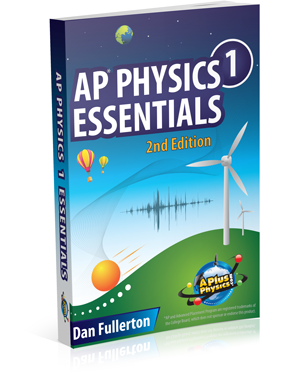
Version 2nd Edition
AP* Physics 1 Essentials is an easy-to-read guide to the entire AP Physics 1 course, featuring more than 600 worked-out problems with full solutions and deeper understanding questions. AP Physics 1 Essentials covers all major topics included in the AP Physics 1 course, including: kinematics, dynamics, momentum, impulse, gravity, uniform circular motion, rotation, work, energy, power, mechanical waves, sound, electrostatics, and circuits. AP Physics 1 Essentials is integrated with the APlusPhysics.com website, which includes online question and answer forums, videos, animations, and supplemental problems to help you master the essential concepts of physics. This book is designed to assist physics students in their high school AP Physics courses both as a guide throughout the course as well as a review book to assist in end-of-course exam preparation. Its focus is on providing the bare bones, essential concepts necessary for success in the course in a straightforward and easy-to-read manner, leaving development of in-depth problem solving and lab work to the classroom, where it is most effective. In short, this is not intended as a substitute for a standard textbook or course, but rather as an invaluable supplementary resource. New 2nd edition includes more than 90 AP-style problems to test your understanding and help prepare you for the AP Physics 1 Exam. Additional supplemental AP-1 level problems are available on the APlusPhysics site. Note: This is a license for a digital download of the PDF version for use by one person only on up to five electronic devices. This document may not be printed, edited, re-distributed, re-sold, or licensed to any other user. Once the file has been downloaded no refunds will be given. *AP and Advanced Placement Program are registered trademarks of the College Board, which does not sponsor or endorse this product.$10 -

Chapter 7: Circular Motion and Rotation Test Your Understanding
veevian posted a question in Homework Help
In the AP Physics I Essentials book, I'm a little bit stuck on question 5 for Chapter 7 Test Your Understanding. The problem states "A marble is rolled separately down two different inclines of the same height as shown below. Compare the speed of the marble at the bottom of incline A to the speed of the marble at the bottom of incline B. Compare the time it takes the marble to reach the bottom of incline A to the time it takes to reach the bottom of incline B." There is also a picture with a ball on top of an incline that is straight, and another picture with a ball on top of an incline that is curved. I can explain why incline B would result in greater speed resulting in faster time due to the cycloid path/Brachistochrone Curve since the marble is aided by gravity and the beginning is steeper so more PE to KE for incline B etc. etc., but I can't explain it mathematically (w/equations and all). I tried using Work-Energy theorem, but that didn't really work...Also, I'm confused on how we connect the concepts of angular motion to this problem. I appreciate the help! -
A 0.15-kilogram baseball moving at 20 m/s is stopped by a catcher in 0.010 seconds. The average force stopping the ball is: (A) 3.0x10^-2 N (B) 3.0X10^0 N (C) 3.0X10^1 N (D) 3.0X10^2 N The explanation says that it takes 0.010 seconds for the baseball to accelerate from 0 m/s to 20 m/s, but that doesn't really match up with the question... Is the wording a little weird?
-
Name: AP Physics 1 2016 FRQ Solutions Category: Exam Prep Date Added: 2016-05-08 Submitter: FizziksGuy Walk-through of the 2016 AP Physics 1 Free Response Questions. Questions can be found at http://apcentral.collegeboard.com/apc/members/exam/exam_information/225288.html. *AP and Advanced Placement Program are registered trademarks of the College Board, which does not sponsor or endorse this work. AP Physics 1 2016 FRQ Solutions
-
Name: AP Physics 1 - Angular Momentum Category: Rotational Motion Date Added: 2015-11-19 Submitter: FizziksGuy Brief introduction to angular momentum for algebra-based physics courses such as AP Physics 1. AP Physics 1 - Angular Momentum
-
 Name: Determining the Static Coefficient of Friction between Tires and Snow Category: Dynamics Date Added: 2015-10-08 Submitter: Flipping Physics We use Newton’s Second Law and Uniformly Accelerated Motion to experimentally determine the Static Coefficient of Friction between Tires and Snow. Want Lecture Notes? This is an AP Physics 1 topic. Content Times: 0:09 Reading and translating the problem 1:03 Visualizing the experiment 1:16 Where to begin? 1:45 Drawing the Free Body Diagram 3:09 Summing the forces in the y-direction 4:47 Summing the forest in the x-direction 6:24 Uniformly Accelerated Motion 7:35 Solving for the coefficient of static friction 8:18 All 9 trials Next Video: Breaking the Force of Gravity into its Components on an Incline Multilingual? Please help translate Flipping Physics videos! Previous Video: Everybody Brought Mass to the Party! 1¢/minute Determining the Static Coefficient of Friction between Tires and Snow
 -
Name: Does the Book Move? An Introductory Friction Problem Category: Dynamics Date Added: 2015-08-19 Submitter: Flipping Physics Determine if the book moves or not and the acceleration of the book. It’s all about static and kinetic friction. Want Lecture Notes? This is an AP Physics 1 topic. Content Times: 0:08 Reading and translating the problem 0:57 5 Steps to help solve any Free Body Diagram problem 1:26 Drawing the Free Body Diagram 2:24 Sum the forces in the y-direction 3:22 Sum the forces in the x-direction 4:56 The answer to part (a) 6:22 Solving part (b) Multilingual? Please help translate Flipping Physics videos! Previous Video: Experimentally Graphing the Force of Friction 1¢/minute Does the Book Move? An Introductory Friction Problem
-
Name: Experimentally Graphing the Force of Friction Category: Dynamics Date Added: 2015-08-19 Submitter: Flipping Physics To help understand the force of friction, mr.p pulls on a wooden block using a force sensor. Want Lecture Notes? This is an AP Physics 1 topic. Content Times: 0:17 Drawing the Free Body Diagram 0:43 Summing the forces in the x-direction 1:21 Graph when the block doesn’t move 1:46 Graph with the block moving Next Video: Does the Book Move? An Introductory Friction Problem Multilingual? Please help translate Flipping Physics videos! Previous Video: Understanding the Force of Friction Equation 1¢/minute Experimentally Graphing the Force of Friction
-
Name: Introduction to Static and Kinetic Friction by Bobby Category: Dynamics Date Added: 2015-08-07 Submitter: Flipping Physics Bobby teaches the basics of friction and the differences between Static and Kinetic Friction. Want Lecture Notes? This is an AP Physics 1 topic. Content Times: 0:11 Basic definition of friction 0:40 What causes friction? 1:30 Static and kinetic friction demonstrated 2:10 Friction is independent of surface area 2:47 The direction of the force of friction Multilingual? Please help translate Flipping Physics videos! Next Video: Introduction to the Coefficient of Friction Previous Video: An Introductory Tension Force Problem 1¢/minute Introduction to Static and Kinetic Friction by Bobby
-
Name: An Introductory Tension Force Problem Category: Dynamics Date Added: 2015-07-30 Submitter: Flipping Physics Learn how to solve a basic tension force problem with demonstration! Want Lecture Notes? This is an AP Physics 1 topic. Content Times: 0:00 The Problem Demonstrated 0:29 5 Steps to Solve and Free Body Diagram Problem 0:50 Drawing the Free Body Diagram 2:03 Resolving Tension Force 1 into its components (numbers dependency) 4:00 Introducing the Equation Holster! 5:11 Redraw the Free Body Diagram 5:32 Sum the forces in the y-direction 7:24 Sum the forces in the x-direction 8:29 Demonstrating our solution is correct Multilingual? Please help translate Flipping Physics videos! Next Video: Introduction to Static and Kinetic Friction by Bobby Previous Video: 5 Steps to Solve any Free Body Diagram Problem 1¢/minute An Introductory Tension Force Problem
-
Name: 5 Steps to Solve any Free Body Diagram Problem Category: Dynamics Date Added: 2015-07-30 Submitter: Flipping Physics Learn how to solve problems that have Free Body Diagrams! Want Lecture Notes? This is an AP Physics 1 topic. Content Times: 0:15 Step 1) Draw the Free Body Diagram 0:50 Step 2) Break Forces into Components 1:37 Step 3) Redraw the Free Body Diagram 2:15 Step 4) Sum the Forces 2:45 Step 5) Sum the Forces (again) 3:13 Review the 5 Steps Multilingual? Please help translate Flipping Physics videos! Next Video: An Introductory Tension Force Problem Previous Video: Introduction to Equilibrium 1¢/minute: http://www.flippingphysics.com/give.html 5 Steps to Solve any Free Body Diagram Problem
-
Name: Introduction to Equilibrium Category: Dynamics Date Added: 2015-07-30 Submitter: Flipping Physics Learn about and see examples of Translational Equilibrium. Want Lecture Notes? This is an AP Physics 1 topic. Content Times: 0:11 What happens to an object in equilibrium? 0:40 Using Newton’s 2nd law to describe what happens… 2:16 Example: Book at rest on an incline 2:45 Example: Car moving at a constant velocity 3:18 Translational equilibrium Multilingual? Please help translate Flipping Physics videos! Next Video: 5 Steps to Solve any Free Body Diagram Problem Previous Video: Understanding the Force of Tension 1¢/minute Introduction to Equilibrium
-
Name: AP Physics 1: Equations to Memorize Category: Exam Prep Date Added: 14 April 2015 - 03:41 PM Submitter: Flipping Physics Short Description: None Provided Equations to memorize for the AP Physics 1 Exam. Want View Video
-
Name: Kinematics Review for AP Physics 1 Category: Exam Prep Date Added: 02 March 2015 - 03:23 PM Submitter: Flipping Physics Short Description: None Provided Review of all of the Kinematics topics covered in the AP Physics 1 curriculum. Plus some bonus introductory stuff. Content Times: 0:26 Vector vs. Scalar 1:22 Component Vectors 2:04 Distance vs. Displacement 2:41 Speed vs. Velocity 3:04 Acceleration 3:26 Motion Graphs 4:29 Free Fall Graphs 6:31 Uniformly Accelerated Motion (UAM) 7:52 How to UAM 8:18 Projectile Motion 9:28 Relative Motion 10:00 Center of Mass Multilingual? View Video
-
Hello! I'm using the "AP Physics Essentials: 1" book to study for my Work, Power, and Energy exam (chapter 5.) I need clarification on question 5.10; how do we decide on the equation to use? I'm so lost on how to make that determination. Thanks!
-
View File AP Physics 1 Essentials - An APlusPhysics Guide AP* Physics 1 Essentials is an easy-to-read guide to the entire AP Physics 1 course, featuring more than 600 worked-out problems with full solutions and deeper understanding questions. AP Physics 1 Essentials covers all major topics included in the AP Physics 1 course, including: kinematics, dynamics, momentum, impulse, gravity, uniform circular motion, rotation, work, energy, power, mechanical waves, sound, electrostatics, and circuits. AP Physics 1 Essentials is integrated with the APlusPhysics.com website, which includes online question and answer forums, videos, animations, and supplemental problems to help you master the essential concepts of physics. This book is designed to assist physics students in their high school AP Physics courses both as a guide throughout the course as well as a review book to assist in end-of-course exam preparation. Its focus is on providing the bare bones, essential concepts necessary for success in the course in a straightforward and easy-to-read manner, leaving development of in-depth problem solving and lab work to the classroom, where it is most effective. In short, this is not intended as a substitute for a standard textbook or course, but rather as an invaluable supplementary resource. New 2nd edition includes more than 90 AP-style problems to test your understanding and help prepare you for the AP Physics 1 Exam. Additional supplemental AP-1 level problems are available on the APlusPhysics site. Note: This is a license for a digital download of the PDF version for use by one person only on up to five electronic devices. This document may not be printed, edited, re-distributed, re-sold, or licensed to any other user. Once the file has been downloaded no refunds will be given. *AP and Advanced Placement Program are registered trademarks of the College Board, which does not sponsor or endorse this product. Submitter FizziksGuy Submitted 11/07/2013 Category Books